Start with the amount and the pattern
Alcohol is not automatically incompatible with weight loss, but it is more than a line in a calorie tracker. It can affect energy intake, eating decisions, sleep, blood pressure, symptoms, and medication safety. The useful question is not simply whether you drink. It is how much you drink, how often, what is in the glass, and what tends to happen afterward.
Counting can be harder than it sounds. According to the CDC, one U.S. standard drink contains about 14 grams of pure alcohol. That is roughly 12 ounces of 5% beer, 5 ounces of 12% wine, or 1.5 ounces of 40% distilled spirits. A large wine pour, strong craft beer, or cocktail containing multiple shots may represent more than one standard drink.
The CDC’s broad public-health message is that drinking less is better for your health than drinking more. The American Heart Association says people who do not drink should not start for a hoped-for health benefit. For adults who choose to drink, the AHA recommends no more than two standard drinks per day for men and one per day for women. Those limits are not a health target or proof that a particular amount is safe for you. Pregnancy, certain medical conditions, interacting medications, alcohol use disorder, driving, and other circumstances can make avoiding alcohol the safer answer.
- Measure the actual pour, alcohol percentage, and number of servings.
- Treat published limits as maximums, not personalized clearance to drink.
How alcohol can affect a calorie deficit
Alcoholic beverages provide calories but few nutrients, according to the National Institute on Alcohol Abuse and Alcoholism. Beer, wine, and spirits all contribute energy; sweetened mixers, syrups, juice, cream, and larger serving sizes can add more. These calories do not prove that a drink will stop fat loss. Body-weight change depends on the broader energy pattern over time.
The surrounding behavior may be just as important. A systematic review and meta-analysis of controlled studies found that adults generally did not compensate for alcohol calories by eating less. Alcohol exposure was also associated with higher food intake and higher total energy intake than comparison conditions. The evidence had important limits, including a concentration of younger adults and variability among studies, so it cannot predict your personal response.
A practical audit separates the drink from the full event. Record the beverage, serving size, mixer, food eaten while drinking, later snacks, and the next morning’s choices. Compare that with similar alcohol-free days. You may find that the drink itself is the main source of extra energy, or that restaurant portions, reduced planning, and late-night food account for more.
Avoid compensating by skipping nutritious meals before drinking. That can leave you hungry and make the pattern harder to interpret. The goal is not to label alcohol as uniquely fattening. It is to identify whether drinking repeatedly makes your chosen calorie and nutrition plan harder to maintain.
- Count mixers and multiple pours, not just the base spirit.
- Look for repeated changes in food intake rather than judging one evening.
Sleep can connect drinking with next-day choices
Alcohol may make you feel sleepy at first, but sedation is not the same as restorative sleep. NIAAA explains that people may fall asleep faster after drinking while experiencing more fragmented sleep and earlier waking. A systematic review of cohort studies found no evidence that alcohol reduced sleep problems and found some evidence that drinking may increase them, although the authors emphasized that more research was needed.
That distinction matters during weight loss. Controlled-trial evidence on sleep restriction suggests that insufficient sleep can increase hunger, appetite, eating occasions, portion size, and energy intake. Putting these findings together creates a plausible pathway: alcohol disrupts your night, and a tired next day makes planned eating or activity more difficult. It does not prove that alcohol caused a craving, missed workout, or weight plateau in any individual case.
Track the sequence instead of assuming it. Note when drinking ended, when you went to bed, awakenings, total sleep, morning fatigue, appetite, cravings, exercise, and meal-planning difficulty. A wearable can add context, but its sleep-stage estimates are not a medical diagnosis.
You may discover that timing, amount, or frequency matters more than the type of beverage. You may also find no consistent connection. Either result is more useful than relying on the belief that a nightcap improves sleep because it helps you fall asleep. Persistent insomnia, loud snoring, breathing pauses, or severe daytime sleepiness deserves discussion with a licensed clinician rather than self-treatment with alcohol.
- Track sleep quality and next-day behavior together.
- Treat alcohol-related sleep disruption as a possibility to test, not a guaranteed explanation.
What alcohol means for blood pressure
Too much alcohol can raise blood pressure. The AHA’s 2025 scientific statement reports that consuming two or more drinks per day can increase blood pressure and that even moderate consumption may worsen hypertension in some people who already have it. Reducing or eliminating alcohol may therefore be one part of a clinician-guided blood-pressure plan. The AHA does not recommend starting to drink wine or another alcoholic beverage for supposed cardiovascular protection.
Current ACC/AHA categories define normal blood pressure as below 120 systolic and below 80 diastolic. Elevated blood pressure is 120–129 systolic and below 80 diastolic. Stage 1 hypertension is 130–139 systolic or 80–89 diastolic, while stage 2 is 140 or higher systolic or 90 or higher diastolic. Measurements are expressed in millimeters of mercury, or mm Hg. If the two numbers fall into different categories, the higher category applies.
These categories help organize risk and clinical decisions, but one home reading does not diagnose hypertension. The CDC describes high blood pressure as readings that are consistently at or above 130/80 mm Hg, and diagnosis belongs to a health professional reviewing properly collected measurements and your overall health.
A reading taken soon after alcohol may also be difficult to compare with a rested baseline. Alcohol, caffeine, exercise, posture, stress, pain, and measurement technique can affect the result. Instead of trying to prove an immediate cause from one number, collect readings under consistent conditions and look for a repeatable pattern.
- Use repeated, properly collected readings to understand your baseline.
- Do not start, stop, or change blood-pressure medicine based on one reading.
Build a blood-pressure log that is actually comparable
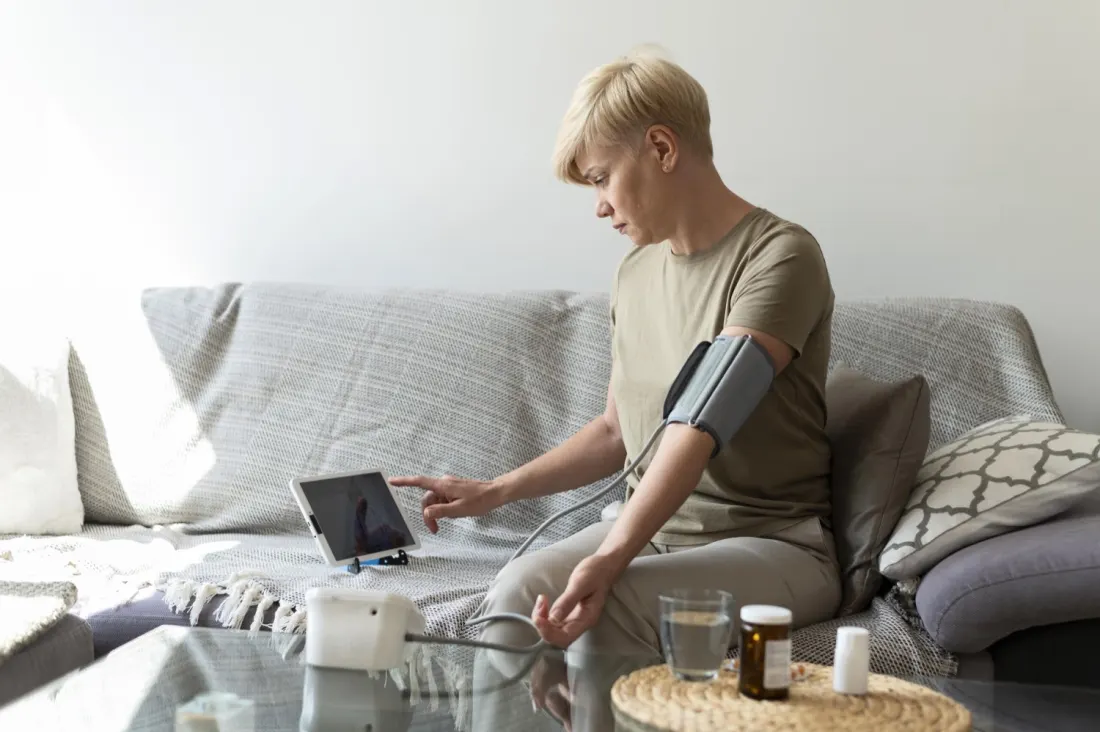
For a useful home log, measurement conditions need to stay as consistent as practical. The CDC advises avoiding food and drink for 30 minutes before measuring; alcohol, caffeine, smoking, or exercise during that window may produce a higher reading. Empty your bladder, then sit quietly with your back supported for at least five minutes. Keep both feet flat, leave your legs uncrossed, support your arm at chest height, place the cuff on bare skin, and do not talk during the measurement.
Use a validated automatic upper-arm monitor with a correctly sized cuff. The CDC recommends measuring at the same time each day and taking at least two readings one or two minutes apart. Your clinician can tell you how often and at what times to measure. Record both numbers rather than selecting the lower result.
Alongside each set, note the date, time, pulse if available, arm used, recent alcohol, medication timing, symptoms, sleep, and anything unusual. This creates context without assuming that alcohol caused every change. Bring the monitor and log to an appointment so the device, cuff fit, and technique can be checked.
If a reading is higher than 180 systolic and/or 120 diastolic, the AHA advises waiting at least one minute and measuring again. If it remains that high, contact a health professional immediately. Call 911 when a reading above that level occurs with chest pain, shortness of breath, back pain, numbness, weakness, vision changes, or difficulty speaking. Do not wait for the number to fall on its own when emergency symptoms are present.
- Take and record at least two readings under standardized conditions.
- Know the difference between a high reading that needs prompt clinical contact and an emergency with symptoms.
Medication safety requires an individual check
There is no reliable category-wide answer to whether alcohol is safe with every medicine used for weight loss or blood pressure. NIAAA warns that alcohol can alter how some medications are absorbed, metabolized, or experienced. Depending on the drug, combinations may contribute to nausea, drowsiness, dizziness, fainting, impaired coordination, breathing problems, bleeding, or changes in blood pressure. Prescription medicines are not the only concern; over-the-counter products, sleep aids, cold medicines, pain relievers, and supplements also belong on the review list.
GLP-1 medications add a relevant but drug-specific consideration. For example, the FDA-approved Wegovy label warns about gastrointestinal reactions and kidney injury associated with dehydration, particularly when nausea, vomiting, or diarrhea occurs. NIAAA separately notes that alcohol can increase urination, disturb sleep, and irritate the stomach. These overlapping effects are a reason to discuss your circumstances with a prescriber or pharmacist, not proof of a direct alcohol–GLP-1 interaction or a universal ban.
Ask about the exact product, dose form, medical conditions, and every other medicine or supplement you use. Useful questions include whether alcohol is contraindicated, which symptoms matter, and whether the timing of a drink changes anything. Read the current medication guide and label each time they are updated.
Do not skip, delay, double, or discontinue a GLP-1 or blood-pressure medicine to accommodate drinking unless your licensed prescriber gives you a specific plan. Seek medical guidance promptly for persistent vomiting, inability to keep fluids down, fainting, severe weakness, or other concerning symptoms.
- Review your complete medication and supplement list, not only the GLP-1 product.
- Ask a pharmacist about the exact beverage–medication interaction rather than relying on a general online rule.
Run a practical, shame-free pattern check
If you want to understand alcohol’s role, define one question at a time. You might investigate stalled weight loss, disrupted sleep, higher home blood-pressure readings, increased stomach symptoms, or difficulty following planned meals. Trying to explain every outcome at once makes the log less useful.
For a couple of typical weeks, record standard drinks, serving sizes, mixers, food, sleep, next-day hunger, activity, blood-pressure readings, symptoms, and whether medicines were taken as prescribed. Include alcohol-free days for comparison when that is safe for you. You are looking for repeated associations, not a perfect streak or proof that one factor caused everything.
If you choose to reduce drinking, concrete environmental changes can help: decide in advance which days will be alcohol-free, plan a nonalcoholic option, measure pours, avoid arriving at an event very hungry, and tell a trusted person what you are testing. CDC also offers a tool for checking drinking patterns and planning ways to drink less.
Bring the record to a licensed clinician or pharmacist. They can interpret it alongside your diagnoses, laboratory results, medications, and personal risk factors. This is especially important if you have high blood pressure, diabetes, liver or kidney disease, recurrent dizziness, or troublesome GLP-1-related symptoms.
If you have been drinking heavily for a prolonged period or have previously experienced withdrawal, do not assume that abruptly stopping is harmless. NIAAA warns that withdrawal can be life-threatening and may involve rapid heart rate, nausea, seizures, or other complications. Contact a medical professional for a safe plan.
- Choose one outcome to investigate and compare repeated patterns.
- Get medical help before abruptly stopping prolonged heavy alcohol use.
Common questions
Can one night of drinking stop weight loss?
One night does not automatically stop fat loss. Alcohol and mixers add energy, however, and drinking may coincide with more food, poorer sleep, or different next-day choices. Your longer-term pattern matters more than treating one drink as a metabolic on/off switch.
Is alcohol safe while using a GLP-1 medication?
There is no universal answer for every GLP-1 product or every person. The exact medication, gastrointestinal symptoms, hydration, diabetes treatment, blood-pressure medicines, other drugs, and medical history can change the risk. Check the current label and ask your prescriber or pharmacist about your complete medication list.
When is a blood-pressure reading after drinking an emergency?
If the reading is higher than 180/120 mm Hg, wait at least one minute and repeat it. If it remains that high, contact a health professional immediately. Call 911 if that level occurs with chest pain, shortness of breath, back pain, numbness, weakness, vision changes, or difficulty speaking.
This information is for general education and does not provide medical advice, diagnosis, or individualized treatment guidance. A licensed clinician or pharmacist can help you interpret your blood pressure, alcohol use, symptoms, and medications together.