
A reminder is not medical guidance
A medication reminder has one safe job: prompt you at a time you entered and, if the app supports it, record what you did. It does not know whether your prescription has changed, whether a new symptom matters, or what a late dose means for your specific medicine. FDA guidance says to follow the label and directions from your doctor or pharmacist and to learn what to do if you miss a dose. That makes your current prescription label and licensed care team—not the app—the source of truth.
Build each reminder by copying the medication name and schedule exactly from the current label and written instructions. Include directions that affect timing, such as whether the medicine is taken with food, only if those directions appear in your instructions. If the label and your memory do not match, or the wording is unclear, ask the prescriber or pharmacist before activating the reminder. Update the app whenever the prescription changes; an old reminder can keep appearing even after the care plan has moved on.
This boundary is especially important with blood-pressure treatment. The American Heart Association says not to stop blood-pressure medication based on home readings without checking with a health care professional. If you also use a GLP-1 medicine for weight management, give it a separate entry based on its own label and schedule. A notification can support consistency, but tapping “taken,” “skipped,” or “snooze” is never permission to change treatment.
- Copy schedules from current written instructions, not memory.
- Resolve unclear directions with a pharmacist or prescriber.
- Update or remove reminders when a prescription changes.
Medication reminders and blood-pressure measurements can live in the same app, but they do different jobs.
Test whether reminders work reliably
Test the reminder system before it becomes part of your routine. Confirm that notifications are allowed, appear on the lock screen in the way you expect, and behave appropriately when your phone is muted or a Focus or do-not-disturb mode is active. Then check what happens after a restart, an operating-system update, low-power mode, airplane mode, and a change in time zone. These are practical reliability checks, not medical tests.
Features vary. Apple’s current Health documentation, for example, describes scheduled dose reminders, an optional follow-up reminder 30 minutes later, “Taken” and “Skipped” logging, and a time-zone-change notice. It also says some schedules require recent operating-system versions. That example shows why you need the official support page for the exact app and phone you use rather than assuming every reminder app behaves the same way.
Look for a history screen that makes unanswered, taken, and skipped entries easy to distinguish. Make sure an accidental tap can be corrected without silently rewriting the schedule. Remember that a log reflects what you entered; it cannot confirm that you actually took the medicine. If you sync across devices, test whether the same item is duplicated or updated everywhere. Finally, keep a separate, current medication list in a place you can reach if the phone is lost, the account is locked, or alerts stop. The app should be a convenience layer, not the only copy of your medication information.
- Test alerts under your normal phone settings.
- Verify time-zone and device-sync behavior.
- Keep an accessible medication list outside the app.
Plan for missed, late, or duplicated alerts
A missed notification and a missed dose are not the same event. You may have taken the medicine without logging it, dismissed the alert accidentally, or received the alert late. Start by identifying what you actually know. Check the app history and your normal routine, but do not let a blank log persuade you to take another dose when you are uncertain.
What to do after a missed or delayed dose depends on the specific medicine, formulation, timing, and instructions you were given. There is no universal app rule that can safely decide “take it now,” “skip it,” or “double the next dose.” FDA guidance recommends knowing the missed-dose instructions for each medicine and following the label and directions from a doctor or pharmacist. The National Institute on Aging likewise lists “If I forget to take my medicine, what should I do?” as a question for your pharmacist.
Create that backup plan before a reminder fails. Keep the pharmacy number and the prescriber’s contact information with your medication list. Save any written missed-dose directions where you can find them without relying on the app. If you are unsure whether you already took a dose, if instructions conflict, or if you feel unwell, contact a pharmacist or licensed clinician for medication-specific guidance. For severe or rapidly worsening symptoms, use urgent or emergency care rather than waiting for the next notification. The safest reminder system makes uncertainty visible and routes decisions back to the people and instructions responsible for your care.
- Do not treat a blank log as proof that a dose was missed.
- Keep medication-specific missed-dose instructions accessible.
- Ask a pharmacist or clinician when you are uncertain.
Keep reminders separate from blood-pressure measurement
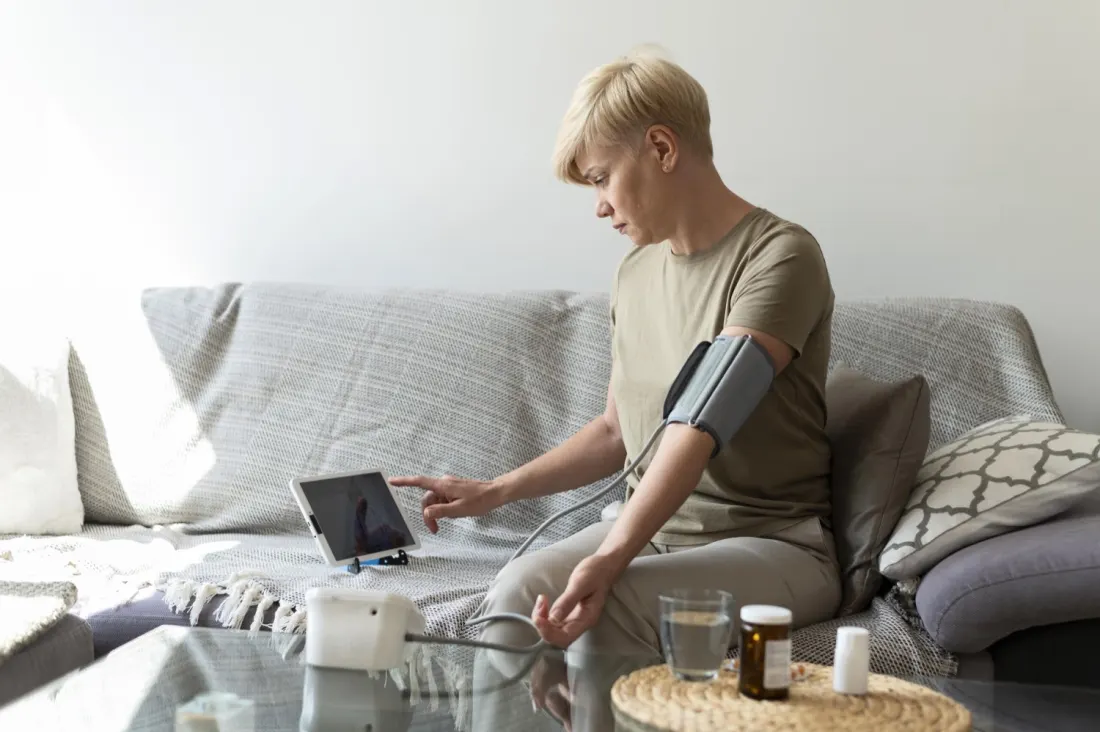
Medication reminders and blood-pressure measurements can live in the same app, but they do different jobs. The reminder supports a routine. The blood-pressure record stores numbers produced by a monitor. A polished graph cannot correct a poor cuff fit, a nonvalidated device, or rushed measurement technique.
For home monitoring, the American Heart Association recommends a validated, automatic, cuff-style upper-arm monitor with a cuff that fits your arm. Before measuring, avoid smoking, caffeine, and exercise for 30 minutes, empty your bladder, and rest quietly for at least five minutes. Sit with your back supported, feet flat, and legs uncrossed. Put the cuff on bare skin, support the arm at heart level, stay quiet, and take two readings one minute apart. Follow your monitor’s instructions and ask your care team how often and when to measure.
For orientation, current AHA adult categories are: normal, below 120 systolic and below 80 diastolic; elevated, 120–129 and below 80; stage 1 hypertension, 130–139 or 80–89; and stage 2, 140 or higher or 90 or higher. The higher category applies when the two numbers fall into different categories. These ranges help describe readings, but an app does not diagnose hypertension from one entry. CDC notes that food or drink, recent activity, nervousness, and body position can affect a measurement. Keep medication logging and measurement logging separate enough that tapping one does not imply the other happened, and record readings accurately rather than entering the number you expected to see.
- Use a validated upper-arm monitor with the correct cuff size.
- Measure using consistent, recommended technique.
- Treat the app as a record, not the measuring instrument.
Use trends to support a clinical conversation
A home blood-pressure log is most useful as a series of properly taken readings that your care team can review. The American Heart Association describes one measurement as a snapshot and says home monitoring does not replace regular visits. A graph may make a pattern easier to see, but it cannot explain the cause. Technique, cuff size, recent activity, stress, illness, and medication timing can all be relevant context for a licensed clinician.
Use notes consistently if the app allows them, and bring or securely share a clear report that includes dates, times, and readings. Avoid editing out numbers simply because they look unusual. Instead, repeat a questionable measurement using proper technique and preserve enough context for your care team to interpret the record. Do not stop, restart, or change blood-pressure medication because an app labels a reading or trend “good,” “high,” or “low” unless your clinician has given you a specific written plan for that situation.
Know the urgent boundary outside the app. AHA guidance says that if a reading is higher than 180 systolic and/or 120 diastolic mm Hg, wait at least one minute and measure again. If it remains that high, contact a health care professional immediately. If the reading is higher than 180/120 and you also have symptoms such as chest pain, shortness of breath, back pain, numbness, weakness, vision changes, or difficulty speaking, call 911. Follow any personalized emergency plan your clinician has given you. Do not wait for an app to analyze the reading or send another reminder.
- Preserve unusual readings instead of hiding them.
- Share dates, times, readings, and relevant notes.
- Never wait for an app during a possible emergency.
Evaluate features, costs, and privacy
Choose an app by checking four areas: clinical boundaries, reliability, useful records, and privacy. First, read the official product page and confirm that the app describes reminders and logging clearly. Be cautious if it claims to interpret readings, predict medication needs, or recommend treatment changes without clearly explaining the clinical basis and professional oversight. A reminder tool should not blur into a prescriber.
Second, verify the exact schedules you need, notification controls, correction options, time-zone behavior, device compatibility, and export format. Test the free version before assuming a paid feature is necessary. Check whether an account, internet connection, subscription, or particular phone or watch is required. App features and prices can change, so use the current official listing rather than an old review.
Third, decide what record is actually useful: a medication list, taken/skipped history, blood-pressure log, notes, or a report for an appointment. More data is not automatically better. A readable record that your care team can understand is the goal.
Finally, read the current privacy policy. Look for what medication and health data the app collects, why it collects it, whether it shares data with other companies, how long it keeps data, and how you can export or delete your account and information. HHS explains that health information entered into a personal app is generally not protected by HIPAA unless the app is provided by a covered entity or business associate. The FTC recommends comparing privacy protections and checking app settings. Keep the app updated, use only the sharing you intend, and maintain a backup outside the app.
- Read the current official listing and privacy policy.
- Check account, subscription, export, and deletion requirements.
- Choose understandable records over a crowded dashboard.
Common questions
What should I do if my medication reminder arrives late?
Do not let the app decide whether to take, delay, skip, or repeat the medicine. Follow the medication-specific missed-dose instructions you were given. If those instructions are unavailable or unclear, contact your pharmacist or licensed clinician.
Can a blood-pressure app tell me to change my medication?
A reminder or tracking app should not replace clinical judgment. Home readings can help your care team evaluate patterns, but you should not stop or change blood-pressure medication based on one number or an app-generated trend unless your clinician has provided a specific plan.
What features matter most in a medication-reminder app?
Prioritize accurate schedule entry, dependable notifications, clear taken/skipped/unanswered records, correction options, time-zone handling, a useful export, transparent costs, and understandable privacy and deletion controls. Keep a separate medication list in case the app or phone becomes unavailable.
This information is for general education and is not medical advice, diagnosis, or treatment guidance. Contact a licensed clinician or pharmacist before changing any medication or blood-pressure care plan.