
Why morning and evening readings can differ
Your blood pressure is not a fixed score. It is a snapshot of the pressure in your arteries at the moment you measure it. The top number, systolic pressure, reflects pressure when your heart beats; the bottom number, diastolic pressure, reflects pressure while your heart rests between beats. Because your activities and measurement conditions change across the day, a morning number and an evening number may differ without either one being “fake.”
The useful question is whether the readings were taken under comparable conditions. A calm morning reading before breakfast is not a fair comparison with an evening reading taken just after exercise, caffeine, alcohol, smoking, a stressful commute, or while your bladder is full. CDC guidance notes that recent caffeine, alcohol, smoking, exercise, and even body position can affect a measurement.
Morning and evening readings can both add information because they sample different parts of your routine. Neither time is automatically the most accurate for every person. A single result also cannot show your usual blood pressure. A consistent series gives your clinician a more useful picture of your levels and whether a care plan appears to be working. If you were given a specific monitoring schedule for symptoms, pregnancy, treatment follow-up, or another reason, that schedule takes priority over a general morning-versus-evening routine.
- Treat each reading as a snapshot, not a final verdict.
- Compare readings taken under similar conditions.
- Look for repeated patterns instead of choosing the highest or lowest result.
For adults, current AHA categories define normal as systolic below 120 and diastolic below 80 mm Hg.
A practical morning-and-evening schedule
For a structured home log, the American Heart Association’s current printable tracker uses two readings in the morning before eating and before taking blood-pressure medication, plus two readings at bedtime before sleep. It suggests collecting readings for at least three days and preferably seven days before an appointment. That is a common comparison schedule, not a universal instruction for every person.
Your clinician may choose different times to answer a different question. For example, the goal may be to review a symptom that occurs at a certain hour or to see what happens across your usual medication schedule. Follow the plan you were given. Do not delay, skip, move, or stop blood-pressure medication simply to produce a particular reading; the AHA specifically advises against stopping medication based on home readings without consulting a health professional.
Consistency matters more than choosing a supposedly perfect clock time. If you are building a routine log, measure at roughly the same points in your morning and evening routines each day. Record the actual time, not just “AM” or “PM,” and note whether the measurement was before or after food and medication. If you work nights, have an irregular schedule, or cannot use the AHA log’s timing, ask your clinician how to adapt it. A repeatable schedule makes day-to-day and morning-to-evening comparisons easier to interpret.
- A common log uses two morning and two bedtime readings.
- Record the actual time and its relationship to food and medication.
- Follow your clinician’s schedule when it differs from a general template.
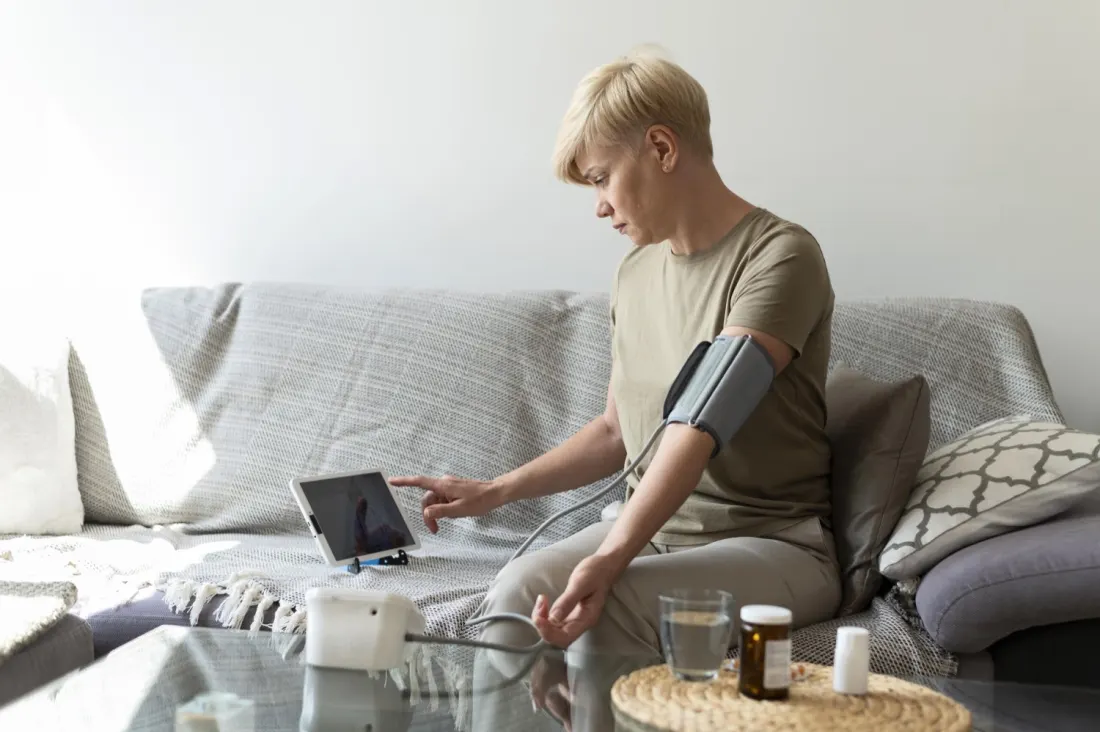
Technique matters as much as timing
Start with an automatic upper-arm monitor that has been validated for clinical accuracy and a cuff sized for your arm. The AHA recommends upper-arm devices for routine home use, and ValidateBP maintains a searchable list of reviewed devices. An incorrect cuff size can make the result inaccurate. Ask a clinician or pharmacist to check your device, cuff fit, and technique, especially when the monitor is new.
For each session, avoid smoking, caffeine, alcohol, and exercise for 30 minutes beforehand. Empty your bladder, then sit quietly for at least five minutes. Use a chair that supports your back. Keep both feet flat, legs uncrossed, and your arm relaxed on a flat surface so the cuff is at heart level. Put the cuff on bare skin, not over clothing. Do not talk, text, scroll, or move while the monitor is running.
Take two readings one minute apart and record both. Using the same arm, chair, device, and approximate times reduces avoidable differences between sessions. If the first number is higher and the second settles, do not hide or automatically discard the first; the pair is part of the record your clinician can review. Also note anything unusual, such as recent activity, poor preparation, symptoms, or an interrupted rest period. Good technique will not make morning and evening numbers identical, but it makes the comparison much more meaningful.
- Use a validated upper-arm monitor with the correct cuff size.
- Rest quietly for at least five minutes before measuring.
- Take and record two readings one minute apart.
How to interpret the numbers without self-diagnosing
For adults, current AHA categories define normal as systolic below 120 and diastolic below 80 mm Hg. Elevated blood pressure is systolic 120–129 with diastolic below 80. Stage 1 hypertension is systolic 130–139 or diastolic 80–89. Stage 2 is systolic 140 or higher or diastolic 90 or higher. The word “or” matters: if the two numbers fall in different categories, the higher category applies to that reading.
These labels help you describe a result; they do not let you diagnose yourself from one morning or evening measurement. Blood pressure can rise and fall, and technique can shift the result. The U.S. Preventive Services Task Force recommends confirming hypertension outside the clinic with a validated home or ambulatory monitor before treatment begins. Your clinician interprets the pattern alongside office measurements, your health history, symptoms, and the reason you are monitoring.
Keep the raw readings rather than reporting only your highest or lowest number. A useful log includes the date, exact time, both readings from each session, and brief context. Bring the monitor or its stored readings to appointments when asked. The AHA also recommends having a clinician compare your home device with office equipment and rechecking it periodically. Your personal treatment goal may differ from the category chart, so use the target and action plan your licensed clinician gives you.
- Normal: below 120 and below 80 mm Hg.
- Stage 1: 130–139 systolic or 80–89 diastolic.
- Stage 2: 140 or higher systolic or 90 or higher diastolic.
What to do with a repeated morning-evening difference
If mornings are repeatedly higher than evenings, or the reverse, first check whether you are comparing like with like. Review the actual times, five-minute rest, cuff placement, posture, bladder status, and whether caffeine, alcohol, smoking, exercise, food, or medication timing differed. A pattern that disappears after you standardize technique may have reflected the measurement conditions rather than a stable difference across your day.
If the difference continues across several properly measured days, share the complete log with your clinician. The direction of the difference alone does not identify a cause and does not tell you how to change treatment. Your care team may review your technique and monitor, ask about your routine and symptoms, compare home and office readings, or decide that ambulatory blood-pressure monitoring would provide more useful out-of-office information. Do not change when or how you take medication unless the prescriber tells you to.
Keep context short and factual so the log remains usable: “before breakfast,” “after poor sleep,” “caffeine within 30 minutes,” “before medication,” or “dizzy” is usually more helpful than trying to explain the reading yourself. If you are losing weight or using a GLP-1 medication, include that in the medication and health context you share with your care team, particularly if your readings or symptoms change. Home readings support a clinical conversation; they are not a substitute for one.
- Standardize your technique before interpreting the difference.
- Record relevant context without trying to diagnose the cause.
- Bring a persistent pattern to a licensed clinician.
Know when a reading needs prompt action
Agree with your clinician in advance on what should trigger a routine message, a same-day call, or emergency help. For an unexpectedly high result, stay still and repeat the measurement using correct technique. The AHA advises waiting at least one minute and checking again when blood pressure is higher than 180 systolic and/or higher than 120 diastolic mm Hg. If the repeat remains in that range without emergency symptoms, contact a health professional immediately for instructions.
Call 911 if a reading higher than 180 and/or 120 occurs with symptoms such as chest pain, shortness of breath, back pain, numbness, weakness, a change in vision, or difficulty speaking. Do not wait for the pressure to fall on its own. Severe new symptoms can require emergency care even when a home monitor seems uncertain, so use the emergency plan rather than repeatedly checking while delaying help.
For longer-term care, lifestyle patterns matter more than explaining one morning or evening number. NHLBI’s DASH eating plan emphasizes vegetables, fruits, whole grains, beans, nuts, fish or poultry, low-fat or fat-free dairy, vegetable oils, and lower-sodium choices while limiting foods high in saturated fat and added sugar. DASH can support blood-pressure management, but yesterday’s meal does not by itself explain a single reading. The practical takeaway is simple: use a consistent schedule, measure correctly, preserve the full record, and involve a licensed clinician when the pattern or symptoms raise concern.
- Repeat a reading above 180 and/or 120 mm Hg after at least one minute.
- Contact a health professional immediately if the repeat remains that high without emergency symptoms.
- Call 911 when that range occurs with serious symptoms.
Common questions
Is a morning or evening blood-pressure reading more accurate?
Neither is automatically more accurate. Both can be useful if you rest first, use correct technique, and measure at consistent points in your routine. A series of comparable readings is more informative than choosing one time as the “real” result.
Should I check before or after taking blood-pressure medication?
Follow the schedule provided by your clinician. The AHA’s general tracking log places the morning readings before food and blood-pressure medication, but that template may not match the clinical question your care team is investigating. Never move, delay, or stop medication solely to change a reading.
What if my first reading is always higher than my second?
Continue taking two readings one minute apart and record both unless your clinician gives different instructions. Make sure you rested for at least five minutes before the first measurement. The pair, along with the timing and context, helps your clinician interpret the pattern.
This content is for general education and is not medical advice, diagnosis, or treatment guidance. Consult a licensed clinician before changing medication, diet, exercise, supplements, or your blood-pressure monitoring plan.