
Protect the reading before troubleshooting
When a blood pressure reading appears on the monitor but not in the app, preserve the information before changing any settings. Record the systolic pressure, diastolic pressure, pulse, date, time, user profile, and arm used. You can also note recent exercise, caffeine, stress, talking, or unusual positioning because those details may help you and your clinician interpret the result later.
Do not assume every monitor handles failed transfers the same way. OMRON says measurements covered by one of its support workflows remain on the device after a failed sync and can transfer during a later attempt. By contrast, Withings warns that factory-resetting its BPM Connect permanently deletes measurements that have not already synced. Those examples show why the support page and manual for your exact model matter before you unpair, reset, or erase anything. (OMRON, Withings)
If you use an iPhone, Apple currently lets you enter the date, time, systolic value, and diastolic value manually in its Blood Pressure Log. A paper log or secure note is another reasonable temporary record. Manual recording does not repair Bluetooth, but it protects continuity while you investigate and gives you something readable to share with a licensed clinician. (Apple Support)
- Preserve the displayed numbers first.
- Confirm the correct date, time, and user profile.
- Delay resets until unsynced readings are protected.
If the measurement appears in the manufacturer app, stop troubleshooting the cuff’s Bluetooth connection.
Find where the transfer stops
A Bluetooth monitor may involve several separate connections. A common path is monitor to manufacturer app, manufacturer app to the company account or cloud, and manufacturer app to Apple Health. Some models also use Wi-Fi, so the exact route can vary. Withings, for example, documents both Bluetooth and Wi-Fi synchronization for BPM Connect, while its app has a separate Apple Health sharing step. (Withings sync support, Withings and Apple Health)
Use the last place where the measurement appears to narrow the problem. If it exists on the monitor but not in the manufacturer app, examine pairing, Bluetooth permission, proximity, battery level, and user assignment. If it appears on the company’s web dashboard but not in its app, the account session or app refresh may be involved. If it appears in the manufacturer app but not in Apple Health, the cuff connection already worked; focus on Health sharing and data-source permissions.
Bluetooth access and Health access are not the same permission. On iPhone, an app must receive permission to use Bluetooth functions, while Health permissions control which data categories an app can read or write. A working Bluetooth link therefore does not prove that the app can write blood pressure data to Health. (Apple Bluetooth permissions, Apple Health data access)
- Monitor only: investigate the device-to-app connection.
- Manufacturer app only: investigate Health sharing.
- Wrong account or profile: investigate user assignment.
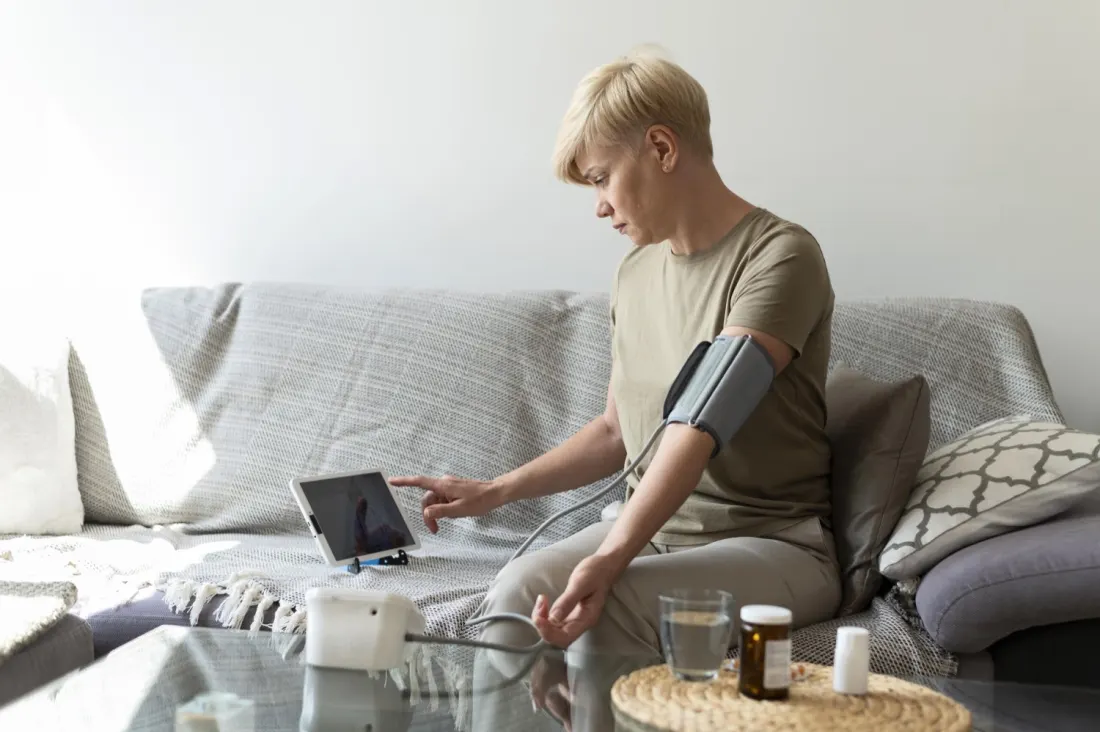
Work through the monitor-to-app checks
Start with low-risk checks. Confirm that your specific monitor and phone operating system are currently supported. Turn on Bluetooth, keep the phone near the monitor, and make sure the manufacturer app has permission to use Bluetooth. On an iPhone, Apple places that control under Settings, Privacy & Security, Bluetooth. Also confirm that the monitor has adequate power and that you are signed into the intended app account. (Apple Support)
User selection matters on shared monitors. OMRON instructs users of certain two-person models to match User ID 1 or 2 on the monitor with the corresponding app user. Withings says a BPM Connect measurement assigned to Guest will not sync to the account. These rules are model-specific, but they illustrate why a successful measurement can still land in the wrong place or nowhere at all. (OMRON two-user support, Withings support)
Next, follow the restart sequence recommended for your model. OMRON’s general support guidance includes checking pairing, toggling Bluetooth, and restarting the phone. Withings tells Bluetooth users of BPM Connect to keep its app open and notes that another previously connected phone can interfere. Do not substitute a generic button sequence: pairing modes, transfer buttons, and memory behavior differ among models. If basic checks fail, use the current manual or official support article for the model number printed on your monitor. (OMRON support)
- Check compatibility, power, proximity, and permissions.
- Verify the account and monitor user ID.
- Use the exact model’s official pairing sequence.
When the app has the reading but Apple Health does not
If the measurement appears in the manufacturer app, stop troubleshooting the cuff’s Bluetooth connection. The first transfer succeeded. Now inspect the separate connection between that app and Apple Health.
Apple’s current instructions say to open Health, select your profile, choose Apps under Privacy, select the manufacturer app, and enable the health categories you want it to contribute. You can also open the Blood Pressure category and review Data Sources & Access to see which apps or devices are supplying that information. The manufacturer app may have its own Health-sharing control as well. Withings, for example, documents sharing systolic pressure, diastolic pressure, and heart rate after the user links the Withings app to Apple Health and grants access. (Apple Support, Withings Support)
If the manufacturer app is absent from Apple’s app list, it may not have requested Health access, may not support that integration, or may require setup inside its own settings. Check its current official compatibility documentation rather than assuming every Bluetooth monitor can write directly to Health.
For continuity, Apple also permits manual blood pressure entry. Review the stored data after automatic syncing returns so that an accidental duplicate does not remain in your history. Manual entry is a recordkeeping fallback, not evidence that the underlying app connection has been repaired.
- Confirm blood pressure write access in Health.
- Check the manufacturer app’s sharing settings.
- Use manual entry as a temporary fallback.
Keep sync reliability separate from measurement accuracy
Bluetooth moves a result; it does not determine whether the cuff produced an accurate one. A failed transfer does not automatically invalidate the number displayed on the monitor, and a clean transfer does not prove that the cuff fit or measurement technique was correct.
For a more dependable home reading, CDC guidance says to rest with your back supported for at least five minutes, place both feet flat on the floor, keep your legs uncrossed, support the cuffed arm at chest height, put the cuff on bare skin, and avoid talking during the measurement. The cuff must also fit your arm correctly. The American Heart Association recommends an automatic, validated upper-arm monitor and notes that an incorrectly sized cuff can produce an inaccurate result. (CDC, AHA)
Current ACC/AHA categories define normal as below 120 systolic and below 80 diastolic; elevated as 120–129 systolic and below 80 diastolic; stage 1 hypertension as 130–139 systolic or 80–89 diastolic; and stage 2 as 140 or higher systolic or 90 or higher diastolic. A licensed clinician, not an app or one isolated reading, confirms a diagnosis. (AHA)
If you are tracking blood pressure during weight loss or GLP-1 care, preserve and share the actual readings with your prescriber. Do not change medication or treatment because an app failed to synchronize.
- Connection status does not validate cuff accuracy.
- Correct technique and cuff size still matter.
- Use trends and clinician review, not one app entry, for health decisions.
Reset carefully and never let the app delay care
Unpairing, reinstalling, and factory-resetting belong near the end of the process. Before using them, confirm that visible readings are recorded, synced measurements are accessible, and you know the credentials for the correct account. Read the exact reset instructions and their data-loss warning. Withings states that a BPM Connect reset preserves data already synced to its app but permanently removes measurements still stored only on the monitor. Other models may behave differently. (Withings Support)
Build a fallback that does not depend entirely on Bluetooth. A dated manual log, the monitor’s internal history, or an exportable report can preserve a usable trend for appointments. When buying a monitor, prioritize independent validation, an upper-arm cuff that fits, current phone and operating-system compatibility, understandable export options, and clear privacy and deletion policies. A Bluetooth logo describes connectivity, not clinical validation. The AHA points readers toward validated devices, and the U.S. ValidateBP listing uses independent expert review of supporting documentation. (AHA, ValidateBP)
Do not wait for an app to work before responding to a concerning result. The AHA says that if blood pressure is higher than 180 systolic and/or higher than 120 diastolic, wait at least one minute and measure again. If it remains that high without symptoms, contact a health care professional as soon as possible. If it is that high with chest pain, shortness of breath, back pain, numbness, weakness, vision changes, difficulty speaking, or another new concerning symptom, call 911. (AHA emergency guidance)
- Back up unsynced readings before resetting.
- Maintain a manual or exportable fallback.
- Respond to the reading and symptoms, not the app status.
Common questions
Does a failed Bluetooth sync mean the blood pressure reading is wrong?
No. Bluetooth transfers the result after the monitor measures it. A transfer failure does not automatically invalidate the displayed reading, but cuff size, placement, rest, posture, movement, and talking can affect measurement accuracy. Record the number and review technique separately.
Can I enter a missing reading manually in Apple Health?
Yes. Apple’s current Blood Pressure Log allows manual entry of the date, time, systolic pressure, and diastolic pressure. If automatic synchronization later restores the same measurement, review your stored data for an accidental duplicate. (Apple Support)
Should I forget the device or factory-reset the monitor?
Only after simpler checks and the official instructions for your exact model. First protect unsynced readings and confirm your account credentials. Reset consequences vary; Withings specifically warns that unsynced BPM Connect measurements are permanently lost during a factory reset.
This content is for general education only and is not medical advice, diagnosis, or treatment guidance. Discuss concerning readings, symptoms, device accuracy, and treatment decisions with a licensed health care professional.