
Find the complete record before exporting
A useful report begins with a simple question: where are your readings actually stored? Your blood-pressure cuff may keep them in its own memory, sync them to the manufacturer’s app, send them to Apple Health, or do more than one of those things. Open the place that contains the complete history before you look for an export button.
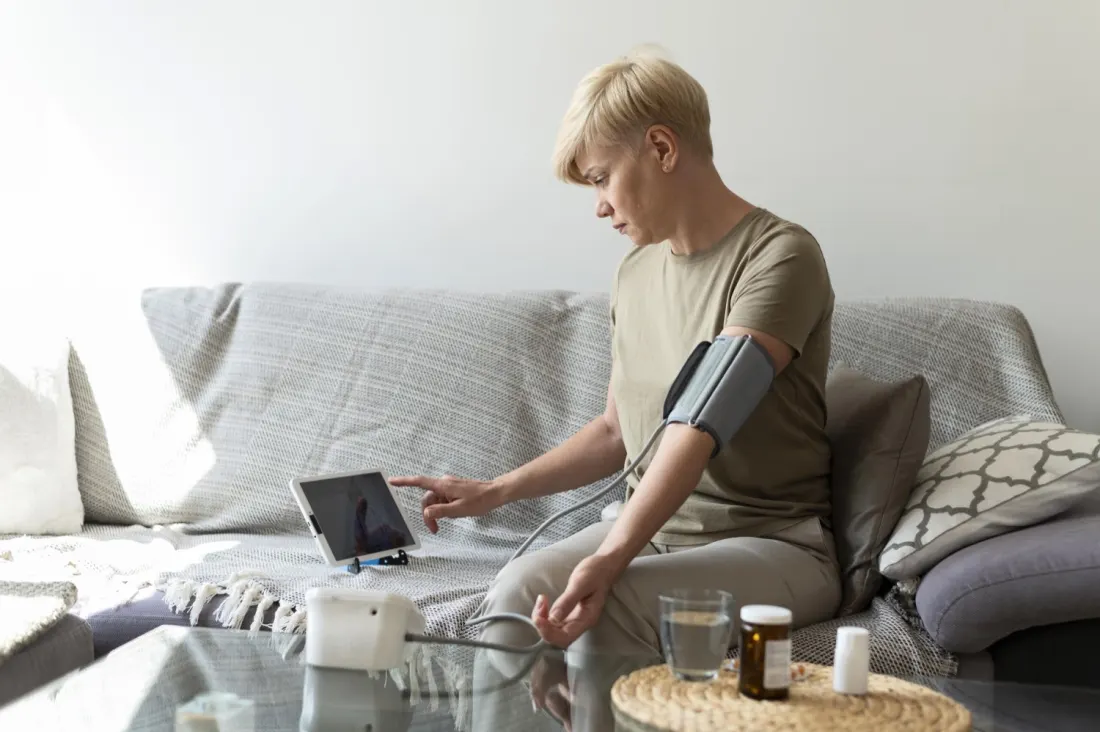
The cuff makes the measurement; the app stores, organizes, graphs, averages, or shares it. That distinction matters because a polished report cannot correct an inaccurate reading. The American Heart Association recommends a validated automatic upper-arm monitor with a cuff that fits. It also advises five minutes of quiet rest, a supported back and arm, feet flat on the floor, the cuff on bare skin, and no smoking, caffeine, or exercise during the 30 minutes before measurement. Your clinician can help check your device and technique.
Use the collection schedule your clinician gave you. If you are tracking blood pressure during weight loss, GLP-1 treatment, or another change in care, do not invent a new schedule from an app prompt. The report’s job is to show what was measured, when it was measured, and any useful context—not to turn app data into a diagnosis.
- Identify the app or device containing the complete history.
- Use a validated monitor with the correct cuff size.
- Follow the measurement schedule provided by your clinician.
App menus change, so confirm the labels on the current official support page if your screen looks different.
Check the history without hiding unusual readings
Before exporting, review the exact date range your clinician requested. Compare the app history with the monitor’s memory or your written log when possible. Look for missing syncs, duplicate rows, readings assigned to another household member, incorrect dates or times, and manual entries that do not match the original record. If the cuff stores several users, confirm that the correct profile was active.
Do not remove a reading merely because it is higher, lower, or less convenient than the rest. The American Heart Association advises recording results and notes that a series of readings provides a more complete picture than one measurement. Selective deletion can hide the pattern your clinician needs to see. If a reading had a known circumstance, add a brief factual note such as “after climbing stairs,” “talked during reading,” or “less than five minutes of rest.” Do not label it “false,” “dangerous,” or “medication failure” unless a licensed clinician has made that assessment.
Keep corrections transparent. Fix an obvious typing error by checking the cuff or original log, but avoid guessing at a missing value. If you took two readings one minute apart, preserve both rather than keeping only the more favorable result. Include pulse only when the device recorded it, and make sure any time-zone or daylight-saving change has not shifted the displayed times.
- Check for gaps, duplicates, wrong-user entries, and sync failures.
- Preserve unusual results and both readings from a measurement session.
- Use short factual notes instead of interpreting the numbers.
Choose a format your doctor can use
Ask the clinic what it wants before you create the file. A PDF is usually the most readable choice for a quick review because it preserves a fixed layout and can be printed or added to a chart. A CSV or spreadsheet is better when the office wants every reading as a separate row for sorting or analysis. Screenshots are a fallback: they can crop dates, omit readings, and force the recipient to compare several images.
At minimum, the report should make the date, time, systolic pressure, and diastolic pressure easy to find. Add pulse if it was measured. Brief notes can explain measurement conditions. A chart or average may help show a pattern, but it should not replace the underlying readings; an average can conceal unusually high or low individual values.
Use only the requested period. A focused report is easier to review and limits unnecessary sharing of health information. Give the file a clear name, such as “BP-report-Jane-Doe-April-1-to-April-14.pdf,” without adding diagnoses or conclusions to the filename. Apple’s “Export All Health Data” is different from a clinic-ready report: Apple says it creates an XML export of all health and fitness data. That archive supports data portability, but unless the clinic specifically requests XML, a focused PDF, CSV, or direct provider-sharing option will usually be easier to use.
- PDF: best for a fixed, readable report.
- CSV or spreadsheet: best for individual data rows.
- Screenshots: use only when no practical export is available.
Export from Apple Health, OMRON Connect, Withings, or SmartBP
App menus change, so confirm the labels on the current official support page if your screen looks different. As of this review, OMRON Connect directs you to History, then the Share icon. You choose the data type and date range, select an available report format, and send the report to yourself or another recipient. OMRON’s support page distinguishes standard and premium report choices, so the options on your account may vary.
In the Withings app, the official workflow starts in the Share tab. Under Healthcare Professional, Health Report creates a PDF after you select a time frame and review the result. Withings also offers HealthLink, a time-limited link for sharing a report. Its support page says reports can include blood pressure and may cover custom dates up to three months.
SmartBP shares records from History. Its official FAQ says CSV export is available and that printing or sharing PDF reports is a premium subscription feature. SmartBP records and analyzes values; it does not measure blood pressure by itself.
Apple Health can share selected data directly with participating U.S. healthcare organizations through Sharing > Share with your doctor. If that option is unavailable, your organization may not support Apple’s provider-sharing feature. Apple’s full export is under your profile in Health as Export All Health Data and produces XML, not a concise blood-pressure PDF. Always verify that the destination contains the readings you expect before exporting.
- OMRON Connect: History > Share.
- Withings: Share > Healthcare Professional > Health Report.
- SmartBP: select records from History, then use the available sharing option.
- Apple Health: Sharing > Share with your doctor, or profile > Export All Health Data.
Preview and deliver the report carefully
Preview the finished report before sending it. Confirm the patient name or profile, requested dates, units, readings, and notes. Make sure the first and last days are present, no page is blank, and the attachment opens on another device if you can test it. If you created both a PDF and a CSV, ask whether the clinic wants both instead of sending extra files automatically.
Blood-pressure reports contain personal health information. Ask the office which delivery method it accepts: a patient-portal upload, secure message, direct app connection, printed copy, fax, or another channel. MedlinePlus describes patient portals as password-protected sites that may support secure messaging, but portal features differ by organization. Because email practices and clinic policies vary, confirm the address and accepted method before using ordinary email.
Before tapping Send, check the recipient carefully and review any notes for information you did not intend to share. Avoid public links or shared folders unless you understand who can access them and for how long. If an app creates a temporary sharing link, tell the clinic when it expires.
Keep a copy if that fits your privacy preferences, then record when and how you sent it. A simple message can state the covered dates and ask the office to confirm receipt. Do not use a portal message for an urgent situation; MedlinePlus advises contacting the office directly for time-sensitive needs.
- Verify the profile, dates, units, notes, and recipient.
- Use the delivery channel accepted by the clinic.
- State the date range and request confirmation of receipt.
Know what the report can—and cannot—tell you
A report organizes evidence; it does not diagnose hypertension or decide treatment. Under the ACC/AHA categories used by the CDC and American Heart Association, normal is below 120 systolic and below 80 diastolic. Elevated is 120–129 systolic with diastolic below 80. Stage 1 hypertension is 130–139 systolic or 80–89 diastolic, and stage 2 is 140 or higher systolic or 90 or higher diastolic. A clinician looks at repeated measurements and your broader health context before confirming a diagnosis.
Do not edit, average away, or postpone attention to a concerning current reading just because you plan to export it later. The American Heart Association says that if a reading is suddenly higher than 180 systolic and/or higher than 120 diastolic, wait at least one minute and measure again. If it remains that high, contact a healthcare professional immediately. If it is higher than 180 and/or 120 and you also have chest pain, shortness of breath, back pain, numbness, weakness, vision changes, or difficulty speaking, call 911.
Use any personalized instructions your clinician has already given you, including different thresholds or a specific contact plan. Do not change blood-pressure medication, supplements, diet, exercise, or a GLP-1 treatment plan because of an app’s color, average, or trend line. Bring the report—and, if requested, your monitor—to the conversation so a licensed clinician can interpret the readings with your symptoms, history, and measurement technique.
- Normal: below 120 and below 80 mm Hg.
- Elevated: 120–129 and below 80 mm Hg.
- Stage 1: 130–139 or 80–89 mm Hg; stage 2: 140 or higher or 90 or higher.
- Follow urgent-reading guidance immediately rather than waiting for an appointment.
Common questions
What if my blood-pressure app does not offer a PDF?
Ask the clinic whether it accepts CSV, spreadsheet data, direct app sharing, or a printed history. If screenshots are the only option, capture the full date range and make sure every image clearly shows the date, time, systolic value, and diastolic value.
Should I delete a reading that looks wrong?
No. Preserve it and, if the reading is current, repeat the measurement using proper technique. Record both results and add a brief factual note if you know that the cuff moved, you talked, or you did not complete the usual rest period.
How much blood-pressure history should I send?
Use the date range and measurement schedule requested by your clinician. If you were not given a range, ask the office before exporting; a focused report is easier to review and avoids sharing unrelated health data.
This content is for general education only and is not medical advice, diagnosis, or treatment guidance. A licensed clinician can interpret your readings and advise you about symptoms, monitoring, and treatment.