
First, separate the app from the measuring device
A blood-pressure app and a blood-pressure monitor do different jobs. The monitor’s cuff and sensors produce the measurement. The app may receive that number through Bluetooth, let you enter it manually, display a graph, calculate an average, schedule reminders, or create a report. A polished interface cannot correct a poorly fitted cuff or an inaccurate monitor.
That distinction matters when an app appears to measure blood pressure using only an iPhone, smartwatch, ring, camera, or other cuffless feature. In 2025, the FDA warned consumers against unauthorized devices and software features that claim to measure or estimate blood pressure. The current ACC/AHA guideline likewise says reliance on cuffless devices should be avoided until their precision and reliability improve. Look for a clear explanation of what actually generates the reading—not simply language about “monitoring” or “tracking.”
Apple’s own Blood Pressure Log also requires readings from a separate blood-pressure cuff. It can organize numbers and prepare a report, but the iPhone is not acting as the cuff.
Before downloading an app, determine whether it is a manual diary, a companion for a particular monitor, or software that makes its own measurement claim. If that description is vague, check the developer’s website and the device documentation before relying on it. Treat Bluetooth connectivity, attractive charts, ratings, and medical-category placement as convenience signals, not evidence of measurement accuracy.
- Identify the device that produces the reading.
- Do not treat Bluetooth or Apple Health support as proof of accuracy.
- Be skeptical of unsupported cuffless measurement claims.
Apple Health can act as a central record, but every number still has a source.
Check the exact cuff model, validation, and fit
Start with the monitor, not the App Store ranking. The American Heart Association recommends an automatic, cuff-style upper-arm monitor for routine home use. It advises choosing a validated device and using a cuff that fits your upper arm. A cuff that is too small or too large can produce inaccurate readings.
Validation is model-specific. A brand may sell several monitors, and the evidence for one model does not automatically apply to another. Compare the complete model number on the box or device with a recognized listing such as the U.S. Blood Pressure Validated Device Listing. That directory uses an independent review process and records the cuff sizes and validation protocols associated with listed devices. If your arm circumference falls outside the available cuff range, app compatibility does not solve the fit problem.
FDA authorization and clinical validation are related checks, but they are not interchangeable marketing terms. The FDA recommends searching its 510(k) database by device name when you need to confirm whether a blood-pressure device has been evaluated and authorized. A clinician or pharmacist can help if the records or model names are unclear.
Finally, verify compatibility at the model level. Confirm that the manufacturer’s current documentation names your iPhone, iOS version, and intended app. A listing that merely says “Bluetooth monitor” may not establish that your exact model can sync. You can still log readings manually if needed, provided the underlying monitor and technique are appropriate.
- Match the complete model number, not just the brand.
- Measure your arm and compare it with the stated cuff range.
- Confirm current iOS and app compatibility before buying.
Reliable tracking begins with reliable technique
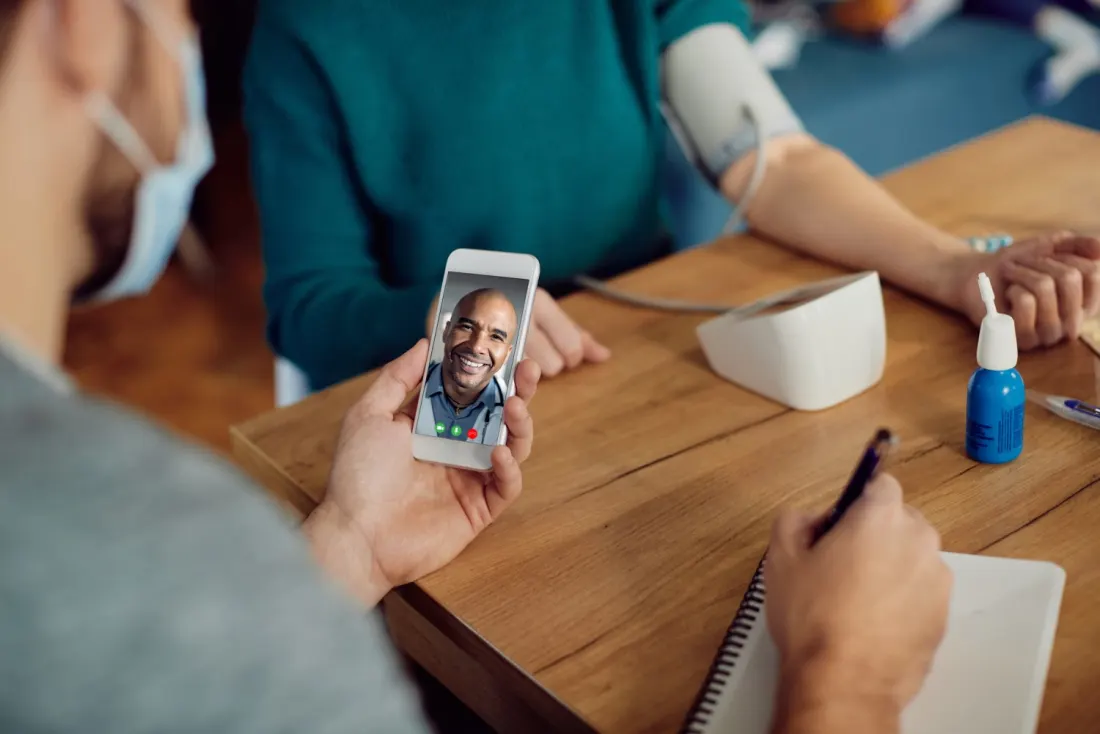
Even a validated monitor can produce misleading numbers when the measuring routine changes. The American Heart Association recommends avoiding smoking, caffeinated drinks, and exercise for at least 30 minutes before measuring. Empty your bladder, then rest quietly for at least five minutes. Sit with your back supported, feet flat on the floor, and legs uncrossed.
Place the correctly sized cuff on bare skin rather than over clothing. Support your arm on a flat surface so the cuff is approximately at heart level. Stay still and avoid talking or using your phone during the reading. Follow the monitor manufacturer’s placement instructions because cuff markings and positioning can vary by model.
The AHA advises taking two readings one minute apart each time you measure and recording both. Ask a licensed clinician how often and at what times to collect readings for your particular situation. Measuring under similar conditions makes a trend easier to interpret than numbers taken at random moments.
Your app can help by providing reminders, timestamps, notes, and separate fields for repeated readings. Look for a workflow that lets you record both measurements rather than silently replacing one with the other. Notes can capture relevant context—such as whether you had just exercised—but they should not become an app-generated diagnosis.
Bring the monitor to a medical appointment so a clinician can review your cuff fit, technique, and results. The useful app is the one that supports a consistent process without making the process appear more precise than it really is.
- Rest and position yourself consistently before measuring.
- Record both readings when taking a pair one minute apart.
- Have a clinician review your monitor and technique.
Audit how readings enter Apple Health
Apple Health can act as a central record, but every number still has a source. Apple currently allows you to enter blood-pressure measurements manually, and compatible apps or accessories can write health data after you grant permission. Apple’s dedicated Blood Pressure Log can display measurements and, after a log is completed, export them as a PDF for discussion with a doctor.
When evaluating another app, identify whether readings are typed manually, transferred directly from a cuff, imported from another service, or copied from Apple Health. Automatic transfer can reduce typing errors, but it can also create confusion if two apps write the same measurement. Run a small test before committing: enter or sync a few readings, confirm their dates and times, and look for duplicates, missing entries, reversed systolic and diastolic values, or incorrect units.
In Health, open the relevant category and review “Data Sources & Access.” Apple says this screen shows which apps and devices contribute that type of data and allows sources to be prioritized or disabled. This is especially useful after replacing a cuff or testing several apps.
If a monitor is shared, confirm how it separates users before enabling automatic sync. A reading assigned to the wrong person can distort both people’s histories. Also check how edits and deletions travel between the app and Apple Health. A clean, traceable record is more valuable than a graph containing numbers whose origin you cannot explain.
- Check the writer, date, time, and units for test readings.
- Look for duplicate records after enabling sync.
- Keep readings from different monitor users separated.
Test export, privacy, and cost before committing
A tracking app becomes more useful when you can move your data out of it. Create a small sample history and test the export. Confirm that the result clearly includes systolic and diastolic pressure, date, time, and any notes your clinician needs. PDF may be convenient for printing, while CSV or another spreadsheet-friendly format can make a longer history easier to review. Export options vary by app and may require payment.
Check what happens if you cancel a subscription, delete the app, change phones, or lose access to your account. Ask whether you can still view and export existing readings. Review the current App Store listing for in-app purchases, trial length, renewal terms, supported devices, version history, and recent developer changes. Listings consulted during this review showed that blood-pressure apps differ substantially in subscriptions, exports, Apple Health syncing, and storage claims, so verify the current version rather than relying on an older comparison.
Privacy needs a separate review. Apple’s App Privacy label can show data types the developer says it collects, whether data may be linked to you, and whether it may be used for tracking. Apple describes these disclosures as self-reported, so also open the developer’s privacy policy. Look for account requirements, off-device storage, third-party service providers, advertising or analytics use, retention, deletion procedures, and a way to contact the developer.
If the app requests Apple Health access, grant only the categories it needs. Apple provides separate controls for health-data access, and you can later review or revoke those permissions.
- Complete a real export test before building a long history.
- Read both the App Privacy label and the privacy policy.
- Verify current subscription, cancellation, and data-access terms.
Make sure the app interprets numbers responsibly
An app’s colors and labels should match current U.S. adult blood-pressure categories. Under ACC/AHA categories, normal is below 120 systolic and below 80 diastolic. Elevated is 120–129 systolic with diastolic below 80. Stage 1 hypertension is 130–139 systolic or 80–89 diastolic. Stage 2 is 140 or higher systolic or 90 or higher diastolic. When the two numbers fall into different categories, the higher category applies.
These labels help organize readings; they do not let an app confirm a diagnosis. Blood pressure varies, and the USPSTF recommends validated home or ambulatory measurements outside a clinical setting to confirm hypertension before treatment begins. A clinician interprets the pattern alongside your medical history, medications, symptoms, and other risk factors.
Also inspect how the app responds to very high readings. The American Heart Association advises repeating a reading after at least one minute when systolic pressure is higher than 180 and/or diastolic pressure is higher than 120. If the repeat remains that high and you have symptoms such as chest pain, shortness of breath, weakness, numbness, vision changes, back pain, or difficulty speaking, call 911. If it remains that high without those symptoms, contact a health care professional promptly.
An app should not encourage you to change medication based on a graph, average, or notification. If you are tracking blood pressure during weight loss or GLP-1 treatment, use the same measurement standards and ask your prescribing clinician how the log fits into your care.
- Compare app labels with current ACC/AHA categories.
- Treat graphs and alerts as records, not diagnoses.
- Use clinician guidance for unusual patterns or care changes.
Common questions
Can an iPhone measure blood pressure without a cuff?
Do not assume that it can. The FDA warns against unauthorized devices and software features that claim to measure or estimate blood pressure, and current ACC/AHA guidance cautions against relying on cuffless devices. For routine home monitoring, use an appropriate validated cuff and treat the iPhone as a logging, syncing, or reporting tool unless a specific measurement system has current FDA authorization and supporting validation.
Is Apple Health enough, or do I need another blood-pressure app?
Apple Health may be enough if you mainly need to enter cuff readings, view them, and use Apple’s supported Blood Pressure Log and PDF workflow. Another app may add direct cuff syncing, custom reports, reminders, or CSV export. Test those features and their privacy terms before paying; an additional app does not make the cuff itself more accurate.
What should I do if the app shows a reading above 180/120?
Follow the AHA’s safety guidance rather than relying on the app’s color or message. Wait at least one minute and measure again. If the repeat is still above 180 systolic and/or 120 diastolic and you have concerning symptoms such as chest pain, shortness of breath, weakness, numbness, vision changes, back pain, or difficulty speaking, call 911. Without those symptoms, contact a health care professional promptly.
This content is for education only and is not medical advice, diagnosis, or treatment guidance. Consult a licensed clinician before changing medication, supplements, diet, exercise, or blood-pressure care.