
What makes a blood pressure record clinically useful
Your clinician gets the most value from a blood pressure record that answers four questions: Was the monitor appropriate? Were readings taken correctly? Is the record complete? Can the pattern be reviewed quickly? A Bluetooth connection answers none of those by itself.
Home readings can add information that one office measurement cannot. The USPSTF recommends confirming a possible hypertension diagnosis with out-of-office measurements from a validated, accurate device before treatment begins. The American Heart Association also describes a series of readings as more informative than one snapshot. What matters clinically is the pattern produced by sound measurements, not whether the numbers arrived on paper or through an app.
A careful manual log can therefore be more useful than an incomplete connected history. Conversely, a connected cuff may be more useful when automatic transfer removes a task you often forget, preserves dates and times, and creates a report your care team can actually open. Research on telemonitoring suggests that automatic transmission can support hypertension care, especially when it is part of an organized care pathway; that is different from proving that any consumer app is better than a notebook.
Treat the cuff and the record as separate tools. The cuff produces the measurement. A notebook, phone, or app stores and presents it. Choose the workflow that gives your clinician accurate readings, the full requested time period, and enough context to interpret unusual results.
- Accuracy and technique come before connectivity.
- A complete paper log can beat an incomplete app history.
- Trends are most useful when collected under consistent conditions.
Measurement quality comes before the logging method
Start with the measuring device, because a polished graph cannot repair a poor measurement. The AHA recommends an automatic, cuff-style upper-arm monitor for home use. Check the exact model—not just the brand—on an independent validated-device list such as ValidateBP. FDA authorization and independent clinical validation are related checks, but they are not interchangeable; the FDA also advises consumers to verify that a device is authorized and to involve a health professional when accurate measurements affect care.
Cuff fit matters. Measure your upper-arm circumference and use a cuff whose stated range includes it. The AHA warns that an incorrectly sized cuff can produce an inaccurate reading. Bring the monitor to an appointment so your care team can check the fit, watch your technique, and compare it with office equipment.
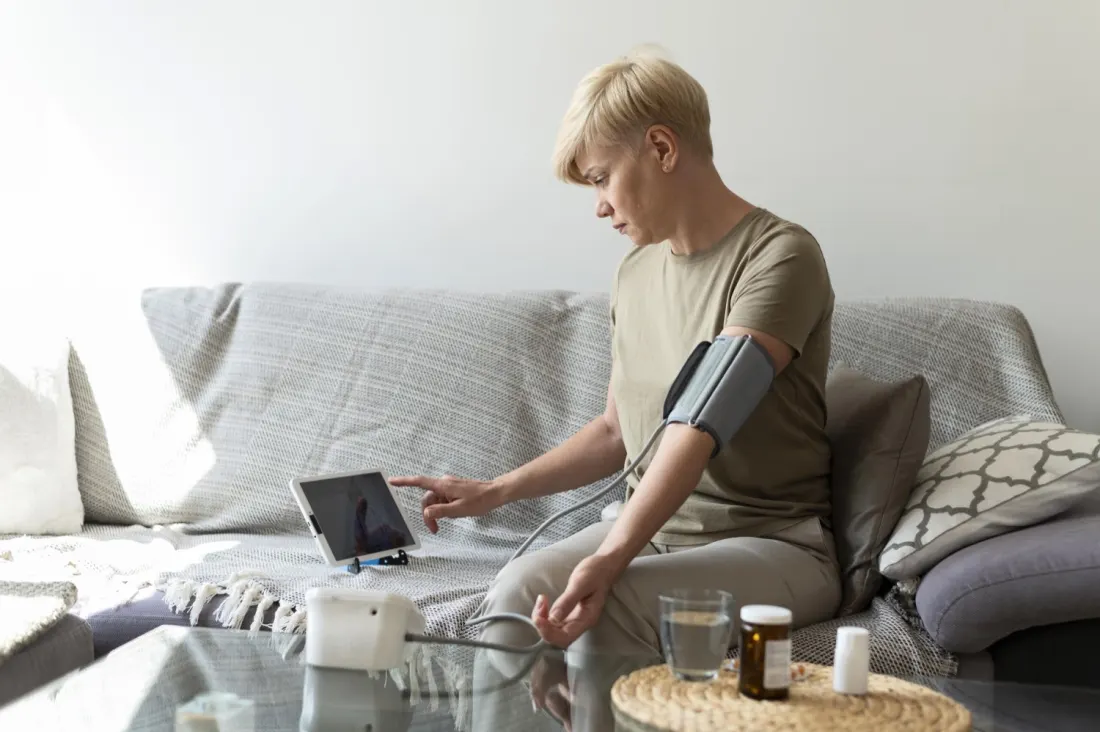
For each session, follow the same routine. Avoid smoking, caffeine, and exercise for 30 minutes beforehand, empty your bladder, and rest quietly for at least five minutes. Sit with your back supported and feet flat. Put the cuff on bare skin, support your arm at heart level, stay still, and do not talk or use your phone during the measurement. The AHA recommends two readings one minute apart and recording the results, while your clinician may give you a different schedule for a specific reason.
These steps apply equally to paper, manual app entry, and connected cuffs. Consistency makes readings comparable; connectivity only changes how they are stored.
- Use a validated automatic upper-arm monitor with the correct cuff size.
- Rest for at least five minutes and support your arm at heart level.
- Unless your clinician specifies otherwise, take two readings one minute apart and record both.
When a manual log works well
A useful manual log is simple and complete. For every requested reading, record the date, time, systolic pressure, and diastolic pressure. If your monitor shows pulse and your clinician asked for it, include that too. Record both measurements when you take the recommended pair rather than keeping only the number you prefer.
Brief context can help, but avoid turning the log into a diary. A short factual note such as “measured after rushing upstairs,” “headache,” or “cuff slipped” can explain why a reading may need discussion. Do not delete an outlier merely because it looks odd. Repeat the measurement according to your care plan, preserve the result, and let the clinician judge the pattern.
Paper is easy to understand and requires no account, pairing, or software. Its weaknesses are practical: readings can be forgotten, digits can be reversed, times can be estimated later, and the notebook can stay home on appointment day. A spreadsheet or note on your phone has similar transcription risks.
Apple’s current Blood Pressure Log is also a manual workflow: you enter the date, time, systolic value, and diastolic value. It can graph measurements and, after a log is completed, export a PDF for a doctor. Availability and requirements can change, so confirm that the feature works on your iPhone and in your region. Before sharing any manual record, scan for impossible dates, reversed numbers, duplicates, and missing sessions without “correcting” genuine readings.
- Record the date, time, systolic value, diastolic value, and both readings in each pair.
- Use short, factual notes only when they help explain the circumstances.
- Review for transcription mistakes without removing genuine outliers.
What a connected cuff adds—and what it cannot prove
A connected cuff can remove the retyping step. Compatible models may send readings by Bluetooth or Wi-Fi to a manufacturer’s app, attach a date and time, display trends, and create a shareable report. OMRON says its connected monitors can upload, store, graph, and share readings through OMRON connect, with free and premium features. Withings’ BPM Connect support documentation describes sharing a complete Health Report from the Withings app.
Those conveniences do not establish measurement accuracy. Validation applies to a specific monitor model and intended population, not to a brand, app, graph, or Bluetooth logo. Confirm the model’s validation and cuff-size range before comparing software features.
Test the entire workflow while you can still return the device. Confirm that a completed reading really appears in the app with the correct time. If several people use the cuff, learn how profiles are assigned and check that records do not mix. Create a sample report and ask whether your clinic accepts that file or prefers a portal message, printed page, or the monitor’s stored memory. Check whether the cuff still measures and stores readings when your phone or Wi-Fi is unavailable.
Also review account, privacy, deletion, compatibility, and subscription details on the current official pages. A feature shown in marketing may depend on the exact model, app version, operating system, country, or paid plan. Connected is helpful when it reliably reduces friction. It becomes less helpful when pairing failures create gaps, household readings are mixed, or the report cannot be opened during the visit.
- Verify the exact cuff model independently before comparing app features.
- Test syncing, timestamps, user profiles, offline behavior, and report export.
- Confirm what is free, what requires payment, and what format your clinic accepts.
Keep the numbers—and urgent readings—in context
A clinician interprets a pattern in context; an app’s color does not make a diagnosis. Under current AHA categories for adults, normal is below 120 systolic and below 80 diastolic. Elevated is 120–129 systolic and below 80 diastolic. Stage 1 hypertension is 130–139 systolic or 80–89 diastolic, and Stage 2 is 140 or higher systolic or 90 or higher diastolic. The CDC likewise describes high blood pressure as consistently at or above 130/80. Only a licensed clinician can confirm a diagnosis and set an individual target.
Keep unexpected readings rather than hiding them. One high result is a reason to repeat the measurement correctly and document both values, not to edit the record until it looks smooth. Contact your care team about repeated readings outside the range they gave you, symptoms, or uncertainty about the monitor. Do not stop or change prescribed medication because of a single home reading, a trend arrow, or an app classification.
Know the urgent exception. The AHA says that if blood pressure is suddenly higher than 180 systolic and/or 120 diastolic, wait at least one minute and measure again. If it remains that high, contact a health professional immediately. If a reading above 180 and/or 120 occurs with symptoms such as chest pain, shortness of breath, back pain, numbness, weakness, vision change, or difficulty speaking, call 911.
Whether the alert appears in an app or on the cuff screen, the response is based on the reading and symptoms—not the logging method.
- Normal: below 120/80; elevated: 120–129 and below 80.
- Stage 1: 130–139 or 80–89; Stage 2: 140 or higher or 90 or higher.
- Above 180 and/or 120 with concerning symptoms is a medical emergency—call 911.
Common questions
Is a connected blood pressure cuff more accurate than a non-connected cuff?
Not necessarily. Connectivity controls how readings are transferred or displayed, not whether the measurement itself is accurate. Check the exact model on an independent validated-device list, confirm that the cuff fits your arm, and use correct technique.
What if my app misses or duplicates a reading?
Keep the cuff’s stored result if available and make a factual correction or note in the record. Review the complete history before sharing it, and avoid deleting valid readings simply to make the graph look cleaner. If syncing problems continue, a disciplined manual log may be more reliable.
Should I bring my home monitor to an appointment?
Yes. The AHA recommends bringing it so your care team can check the cuff fit, observe your technique, and compare its readings with office equipment. Also bring the paper log, exported report, or monitor memory your clinician asked to review.
This content is for general education only and is not medical advice, diagnosis, or treatment guidance. Consult a licensed clinician before changing medication, diet, exercise, supplements, or blood pressure care.