
Why your monitor belongs in the exam room
Home blood-pressure readings can give your care team information that a single office measurement cannot. Blood pressure changes throughout the day, and the U.S. Preventive Services Task Force recommends measurements outside a clinical setting to confirm a hypertension diagnosis before treatment begins. Home monitoring may also help a clinician evaluate how an existing care plan is working. It does not replace regular appointments or establish a diagnosis by itself.
Bring the complete setup you actually use: the monitor, cuff, tubing, and power adapter if needed. Bring your phone if readings are stored in an app, or carry the paper log you use. A photo of the device label, box, or manual can help identify the exact brand and model. If the monitor stores measurements internally, avoid clearing its memory before the visit.
During the appointment, show how you normally measure—not an improved version created for the exam room. Your clinician can inspect the cuff, watch your positioning, review the device settings, and compare the results with office equipment. The American Heart Association recommends taking a home monitor to your next appointment and bringing it back about once a year, or as directed by the manufacturer, for another accuracy check. Bring it sooner if it is dropped, damaged, or begins producing readings that seem unexpectedly inconsistent.
- Monitor, cuff, tubing, and power adapter
- App, device memory, or paper reading log
- Brand, model number, manual, or box
Your clinician may take several readings with the office equipment and your home monitor under similar conditions.
First verify the device and cuff
The American Heart Association generally recommends an automatic, cuff-style monitor that measures at the upper arm. Wrist and finger devices are more sensitive to positioning and are not its preferred choice for routine home monitoring. An upper-arm device still needs two checks: whether the model has been validated for clinical accuracy and whether its cuff fits your arm.
Validation is more than a manufacturer describing a monitor as accurate. ValidateBP maintains a U.S. Validated Device Listing. Its independent committee reviews documentation against established criteria, including appropriate cuff availability, an active FDA clearance record, and independent testing under an accepted validation protocol. Search using the precise model number because similar-looking models are not necessarily interchangeable. If your monitor is absent from the list, that does not prove it is inaccurate; ValidateBP notes that a device may not have been submitted or may still be under review. Ask your clinician or pharmacist how to interpret its status.
Cuff fit is equally important. The cuff should cover an arm circumference within the range printed on the cuff or in the manual. A randomized crossover trial published in JAMA Internal Medicine found that using an incorrectly sized cuff with an automated device produced inaccurate readings: a cuff that was too small tended to read higher, while one that was too large tended to read lower. At the appointment, ask the care team to measure your arm and confirm the cuff range rather than relying on labels such as standard or large.
- Confirm the exact model, not only the brand
- Check the model on a validated-device list
- Match the printed cuff range to your measured arm
Demonstrate your real measurement routine
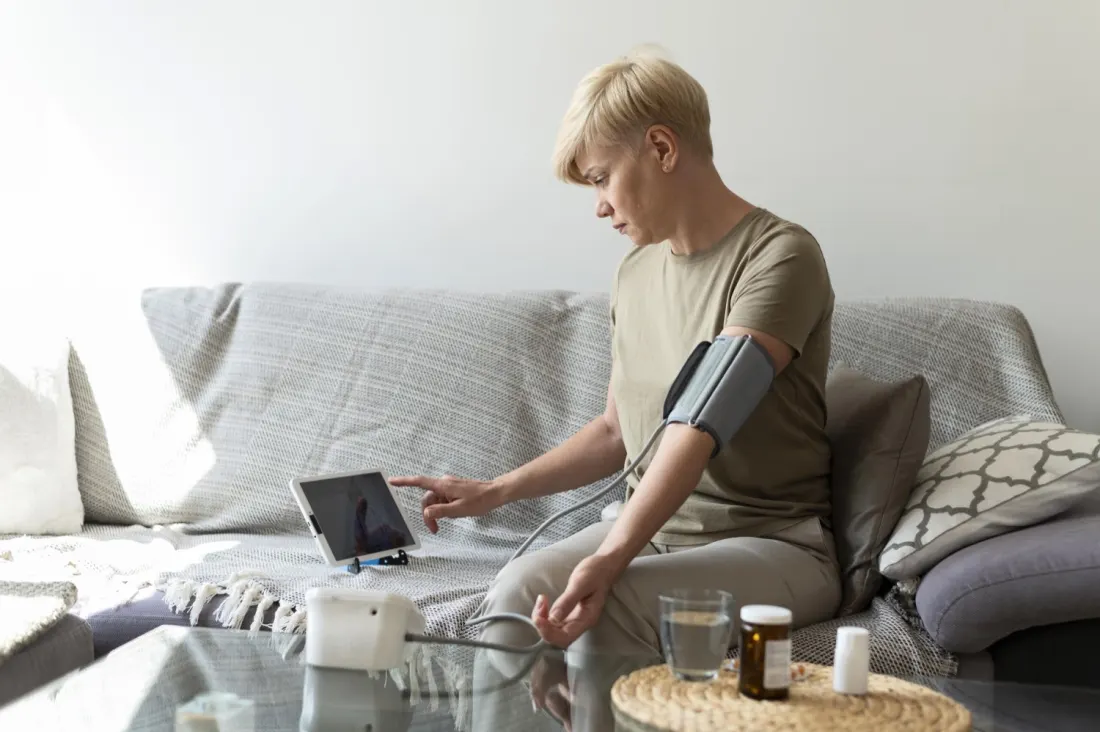
Small setup differences can change a blood-pressure reading, so let the care team watch your usual routine from beginning to end. A careful method begins before the cuff inflates. The AHA advises avoiding smoking, caffeinated drinks, and exercise for at least 30 minutes beforehand and emptying your bladder. Sit quietly for at least five minutes before measuring.
Use a chair that supports your back. Keep both feet flat on the floor and your legs uncrossed. Place the cuff directly against bare skin rather than over a sleeve. Support your arm on a table or other flat surface so the middle of the cuff is at heart level. Position the cuff according to the device instructions; for a typical upper-arm cuff, its lower edge sits just above the bend of the elbow. Stay still, do not talk, and avoid using your phone while the monitor is running.
Ask the clinician to correct you while you repeat the process. Useful questions include where the cuff marker belongs, whether the tubing position matters for your model, which arm to use consistently, and what time of day fits your monitoring plan. The AHA’s general instructions call for two readings one minute apart each time you measure, but your clinician may recommend a different schedule based on why you are monitoring. Consistency matters: readings collected under similar conditions are easier to interpret as a pattern.
- Rest quietly for at least five minutes
- Support your back, feet, and arm
- Measure on bare skin without talking
Compare readings without expecting identical numbers
Your clinician may take several readings with the office equipment and your home monitor under similar conditions. The purpose is not to force two machines to display the exact same number. Blood pressure varies from moment to moment, and repeated measurements can differ even when the same device is used correctly. The care team is looking for a difference large or consistent enough to question the device, cuff, or technique.
Your log should also be interpreted as a series rather than as isolated numbers. Under current AHA categories, normal is a systolic reading below 120 and a diastolic reading below 80 mm Hg. Elevated blood pressure is systolic 120–129 with diastolic below 80. Stage 1 hypertension is systolic 130–139 or diastolic 80–89. Stage 2 is systolic 140 or higher or diastolic 90 or higher. When the two numbers fall into different categories, the higher category applies.
These categories provide shared language; they are not a self-diagnosis from one home result. The CDC describes hypertension as blood pressure that is consistently at or above 130/80, and only a qualified health professional can confirm the diagnosis. Home and office patterns may differ, which is one reason out-of-office measurements are useful. Ask whether your monitor’s readings are dependable enough to follow, what range your clinician wants you to track, and when the device should be checked again.
- Expect some normal variation between readings
- Use the higher category when the two numbers differ
- Let a clinician interpret the pattern and your overall risk
Build a log that explains the pattern
A useful blood-pressure log is brief, consistent, and specific. Record the date, time, systolic number, diastolic number, and each repeat measurement rather than keeping only the result you prefer. If your clinician asks you to measure at particular times, label readings clearly—for example, morning or evening—without changing the schedule on your own.
Add short notes when something may help explain an unusual result. Relevant context can include symptoms, recent caffeine, smoking, exercise, alcohol, poor sleep, acute illness, stress, or a major change in food or fluid intake. Record medications and supplements accurately, including whether a measurement was taken before or after your usual medication time. This is context for the clinician, not a reason to skip, add, or adjust a dose.
If you use a GLP-1 medication for weight management or diabetes, include its exact name on your medication list. Also mention persistent nausea, vomiting, diarrhea, faintness, or markedly reduced food or fluid intake. FDA-approved semaglutide labeling warns that gastrointestinal adverse effects can contribute to dehydration, so this information may matter when a clinician interprets symptoms and blood-pressure changes. Different GLP-1 medicines have different labeling and risks; do not assume one product’s instructions apply to another.
Bring both ordinary and surprising readings. A clinician needs the full pattern, including repeat results, to decide whether the monitor, your method, or a health change deserves closer attention.
- Keep every reading, not only the lowest one
- Add short context notes when relevant
- Never change medication from the log alone
Leave with a clear response plan
Before the appointment ends, ask for a written or clearly stated plan. Confirm how often to measure, whether to take two readings, which arm to use, how many days of results to collect, and how to share them. Ask what pattern warrants a routine portal message, what requires a prompt call, and what constitutes an emergency for you. Personalized instructions may differ because your clinician considers your symptoms, medical history, pregnancy status, medications, and cardiovascular risk—not only one number.
The AHA advises that if either number is higher than 180 systolic and/or higher than 120 diastolic, wait at least one minute and measure again. If the repeat remains that high and you have chest pain, shortness of breath, back pain, numbness, weakness, a change in vision, difficulty speaking, or another new concerning symptom, call 911. Do not wait for the pressure to decrease on its own. If the repeat remains that high without those symptoms, contact a health professional promptly for guidance. Follow any individualized emergency plan you have already received.
You can also ask whether nutrition belongs in your longer-term plan. NHLBI describes DASH as a flexible eating pattern emphasizing vegetables, fruits, whole grains, low-fat dairy, fish, poultry, beans, nuts, and vegetable oils while limiting sodium, saturated fat, and sugary foods and drinks. Its application should reflect your calorie needs, kidney function, medications, food tolerance, and other clinical considerations, especially while losing weight or using GLP-1 medication.
- Agree on routine, prompt, and emergency thresholds
- Know how and where to send your readings
- Fit nutrition changes to your full medical context
Common questions
What if my monitor is not listed on ValidateBP?
An absent listing does not automatically mean the monitor is inaccurate. ValidateBP says the manufacturer may not have submitted it or its review may still be pending. Bring the exact model to your clinician or pharmacist and ask whether to keep using it, compare it with another device, or choose a validated replacement.
Why are my home and office readings different?
Blood pressure changes throughout the day, and posture, rest, cuff fit, activity, stress, and measurement technique can affect a result. Out-of-office monitoring helps your clinician evaluate the pattern. Bring your monitor and log so the device and your method can be checked under comparable conditions.
What should I do with a reading higher than 180/120?
The AHA advises waiting at least one minute and measuring again. If the repeat is still higher than 180 systolic and/or higher than 120 diastolic and you have chest pain, shortness of breath, back pain, numbness, weakness, vision changes, difficulty speaking, or another new concerning symptom, call 911. Without those symptoms, contact a health professional promptly and follow your personalized plan.
This content is for general education and does not provide medical advice, diagnosis, or treatment. Consult a licensed clinician before changing medications, diet, exercise, supplements, or your blood-pressure care plan.