
Pack the monitor and every part it needs
Travel is easiest when you pack the monitor you already know how to use. The American Heart Association recommends an automatic, validated, cuff-style upper-arm monitor, with a cuff that matches your arm circumference. A wrong-size cuff can produce an inaccurate result. If you are unsure whether your model has been validated for clinical accuracy, check the current U.S. Validated Device Listing or ask a clinician or pharmacist.
Keep the monitor, its matching cuff, power adapter or charger, fresh batteries, and manufacturer instructions together. Add a paper log and pen even if the monitor has memory or a companion app. A protective case can keep tubing, connectors, and the display from being crushed. Follow the manufacturer’s stated storage temperature and humidity limits; those limits are device-specific, so do not guess from another model’s manual.
For air travel, identify the battery type before packing. Current FAA guidance says dry-cell batteries such as common AA or AAA batteries must be protected from damage and short circuit. TSA, FAA, and airline requirements can differ by battery type, so recheck all three close to departure. Keep spare battery terminals protected using a method allowed by current guidance.
- Monitor and correctly sized cuff
- Power supply and protected spare batteries
- Manufacturer instructions, protective case, and backup log
A travel-day reading can reflect both your blood pressure and the conditions around the measurement.
Test the complete system before departure
Run the entire travel setup before you leave, not just the monitor itself. Take a reading with the exact cuff, batteries or charger, phone, and app you plan to carry. Confirm that the display is readable, the cuff inflates normally, the tubing and connectors are intact, and the cuff still fits your upper arm. If anything behaves differently from your usual setup, check the manufacturer’s official troubleshooting instructions or contact its support channel before the trip.
Check the monitor’s date, time, and user profile, especially if more than one person shares the device. If the monitor pairs with an app, verify that pairing, local storage, sign-in, and export work while you still have reliable internet access. Then switch off Wi-Fi or cellular data and confirm what you can still view. An app can organize readings, but it cannot correct a poorly fitting cuff, unsupported arm, or rushed measurement.
Bring the monitoring plan you made with your licensed clinician: when to measure, how many readings to take, what range or pattern should prompt contact, and which symptoms need urgent help. Save the clinician’s number and your insurance or telehealth details. If you cross time zones or use blood-pressure or GLP-1 medication, ask before departure how the schedule should be handled. The AHA advises against stopping blood-pressure medication based on home readings without consulting a health professional, and one travel reading is not a reason to change a dose yourself.
- Test using the exact equipment you will carry
- Check the clock, user profile, app, and offline access
- Carry your clinician’s instructions and contact information
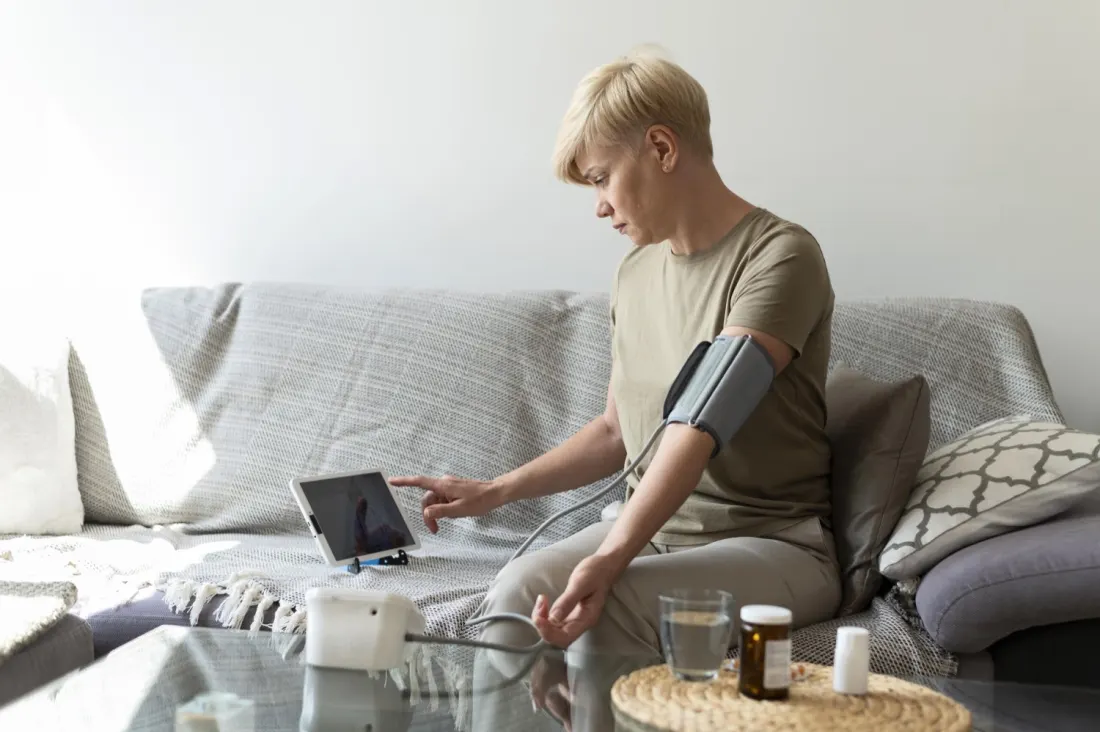
Recreate a reliable measurement position
Choose a measurement spot soon after you arrive. Look for a firm chair with back support and a table or desk that lets your forearm rest with the cuff at heart level. A soft sofa, bed, car seat, or airport gate may make the standard posture difficult to reproduce. If the only available setting is imperfect, record that context instead of treating the result as directly comparable with your usual home readings.
For a routine reading, follow the same preparation you use at home. CDC guidance says to avoid eating or drinking for 30 minutes beforehand, empty your bladder, sit with your back supported for at least five minutes, keep both feet flat and your legs uncrossed, support the cuffed arm at chest height, place the cuff on bare skin, and remain quiet during measurement. The AHA also advises avoiding smoking, caffeine, and exercise during the 30 minutes before a reading.
Put the cuff on the same arm you normally use unless your clinician has told you otherwise. Do not place it over clothing or let the arm hang unsupported. Follow your device instructions for cuff orientation and placement. If your plan calls for repeated measurements, the AHA describes taking two readings one minute apart and recording both. Consistency matters more than finding a perfect hotel room: the goal is to reduce avoidable measurement differences so the record is easier to interpret.
- Use a firm chair with your back supported
- Support the cuffed arm at heart level
- Keep your feet flat, use bare skin, and remain quiet
Make travel readings comparable with home
A travel-day reading can reflect both your blood pressure and the conditions around the measurement. The CDC notes that recent exercise, caffeine, alcohol, smoking, food, anxiety, and body position can affect a reading. A number taken immediately after carrying luggage, rushing through a terminal, drinking coffee, or sitting with your arm unsupported was not collected under the same conditions as a quiet morning reading at home.
Do not respond by checking every few minutes until you see a number you like. Instead, return to your usual technique: settle in, complete the recommended quiet rest, position yourself correctly, and follow the repeat-measurement instructions in your clinician’s plan or device manual. Record the circumstances if the reading still differs from your normal pattern. Useful notes might include recent activity, caffeine or alcohol, a meal, missed sleep, symptoms, a time-zone change, or an unusual measurement location.
Try to measure at the same local time and under similar conditions each day unless your clinician gave different instructions. If a time-zone change makes that confusing, clarify the schedule before travel rather than improvising. MedlinePlus explains that blood pressure can go up and down and that diagnosis generally depends on multiple readings plus clinical context, not one isolated number. Travel monitoring is therefore most useful as a consistent series that a licensed clinician can interpret alongside your symptoms, medicines, and health history.
- Rest and reset your position before rechecking
- Record activity, food, drinks, symptoms, and schedule changes
- Follow a consistent schedule instead of chasing one number
Keep a log and understand what the numbers mean
Use one simple log that you can retrieve without internet access. Record the systolic number, diastolic number, local date and time, and any context that could help explain an unusual result. If you take two readings, keep both rather than saving only the lower one. AHA and CDC home-monitoring guidance recommends recording repeated measurements because a series gives your care team more information than a single snapshot.
For adults, current AHA categories are: normal, below 120 systolic and below 80 diastolic; elevated, 120–129 systolic and below 80 diastolic; stage 1 hypertension, 130–139 systolic or 80–89 diastolic; and stage 2 hypertension, 140 or higher systolic or 90 or higher diastolic. These categories describe the reading, not a diagnosis made from one travel check. Your clinician may give you an individualized target or contact threshold based on your health and treatment plan.
If you use an app, review the manufacturer’s official information for account access, offline behavior, data export, privacy settings, deletion controls, and any subscription requirements. Export or print a sample before leaving. Keep a backup log because a lost phone, expired login, failed Bluetooth connection, or unavailable cloud service should not erase the clinical record. When you return, share the log in the format your care team accepts; do not assume that a proprietary app automatically sends data to your clinician.
- Save every requested reading, not only the lowest
- Use the local date and time and add useful context
- Keep an offline backup you can share later
Know when a travel reading needs escalation
Decide before departure what you will do with an unusual reading. Home monitoring does not replace regular clinical care. Your travel plan should identify a routine contact route, an after-hours option, and how to reach emergency services at your destination. If you are outside the United States, confirm the local emergency number.
For a nonpregnant adult whose blood pressure is higher than 180/120 mm Hg, current AHA emergency guidance says to wait at least one minute and measure again. If the second reading remains that high but you have no new concerning symptoms, contact a health care professional as soon as possible. If a reading higher than 180/120 occurs with chest pain, shortness of breath, back pain, numbness, weakness, vision change, difficulty speaking, or another new concerning symptom, call 911 in the United States or the local emergency number. Do not wait for the app to sync or for the number to fall on its own.
Symptoms can matter even when a device is unavailable or gives an error. Severe chest pain, difficulty breathing, stroke-like symptoms, loss of consciousness, or another apparent medical emergency calls for emergency help. For lower but unexpected readings, follow your clinician’s personalized instructions, note symptoms and context, and avoid self-adjusting medication. The safest travel setup combines reliable technique with a clear human care plan.
- Know your routine and after-hours contact routes
- For a nonpregnant adult, recheck a reading higher than 180/120 after at least one minute
- Call emergency services for a very high reading with new concerning symptoms
Common questions
Can I check my blood pressure in an airport, car, or hotel bed?
You can record a reading if necessary, but those locations may prevent the supported posture used for a standard measurement. Note the setting and recent activity, then follow your clinician’s plan for repeating the measurement under quieter, properly supported conditions when possible.
What if the monitor works but its app will not sync?
Write down the numbers shown on the monitor, including the local date and time. Accurate measurement depends on a validated device, the correct cuff, and good technique—not Bluetooth or cloud access. Use the manufacturer’s official support information before resetting the monitor or app if doing so could erase stored readings.
What should I do if the monitor shows a reading higher than 180/120?
For a nonpregnant adult, the AHA says to wait at least one minute and measure again. If the second reading remains that high without new concerning symptoms, contact a health professional as soon as possible; if it occurs with chest pain, breathing difficulty, weakness, numbness, vision change, difficulty speaking, or another new concerning symptom, call 911 or the local emergency number. Pregnancy requires pregnancy-specific guidance from your care team.
This content is for educational purposes only and is not medical advice, diagnosis, or treatment. Consult a licensed clinician about your monitoring plan and before changing any medication or blood-pressure care.