Start by understanding both numbers
Blood pressure is written as two numbers in millimeters of mercury (mm Hg). The systolic number, on top, reflects pressure while your heart beats; the diastolic number, on the bottom, reflects pressure while your heart rests between beats. Either number can place a reading in a higher category. For nonpregnant adults, the American Heart Association (AHA) classifies normal as below 120 and below 80; elevated as 120–129 and below 80; stage 1 hypertension as 130–139 or 80–89; and stage 2 as 140 or higher or 90 or higher. A reading higher than 180 systolic and/or higher than 120 diastolic is in the severe range. That means 184/78 and 146/124 both qualify; you do not need both numbers to cross the threshold. AHA’s current category chart uses “higher than,” so a reading of exactly 180 or exactly 120 is not worded the same way as one above those values. Still, do not use that technical distinction to dismiss symptoms or a clinician’s personal action plan. Blood pressure changes during the day, and one non-emergency reading does not by itself confirm chronic hypertension. The CDC describes hypertension as blood pressure that is consistently at or above 130/80, while the USPSTF recommends out-of-office confirmation before treatment is started in adults being screened. Severe readings are different: they require an immediate symptom check and a clear next step.
- Either the top or bottom number can determine the category.
- Higher than 180 systolic and/or higher than 120 diastolic is severe for nonpregnant adults.
- Symptoms and your personal medical plan take priority over category labels.
For readings below the severe range, patterns usually teach more than one isolated number.
Know when to call 911—and when to repeat
If your systolic pressure is higher than 180, your diastolic pressure is higher than 120, or both, first pay attention to how you feel. Call 911 when a reading in that range occurs with chest pain, shortness of breath, back pain, numbness, weakness, a vision change, difficulty speaking, or another new and concerning symptom. The AHA calls this a hypertensive emergency and says not to wait for the pressure to come down on its own. Do not spend time changing cuffs, searching online for a remedy, or trying to explain the number before calling. If the reading is higher than 180 and/or 120 but you have none of those concerning symptoms, wait at least one minute and measure again. If the second reading is still just as high, contact a health care professional as soon as possible for guidance. A clinician needs to decide what the reading means and what happens next; feeling normal does not prove that it is harmless because high blood pressure often has no warning signs or symptoms, according to the CDC. If your clinician has already given you an emergency plan or a different threshold because of your medical history, follow that plan. This pathway applies to nonpregnant adults. Pregnancy and the postpartum period require separate guidance, covered below.
- Severe reading plus concerning symptoms: call 911.
- Severe reading without symptoms: wait at least one minute and measure again.
- Second reading still severe: contact a health care professional promptly.
Repeat the measurement correctly
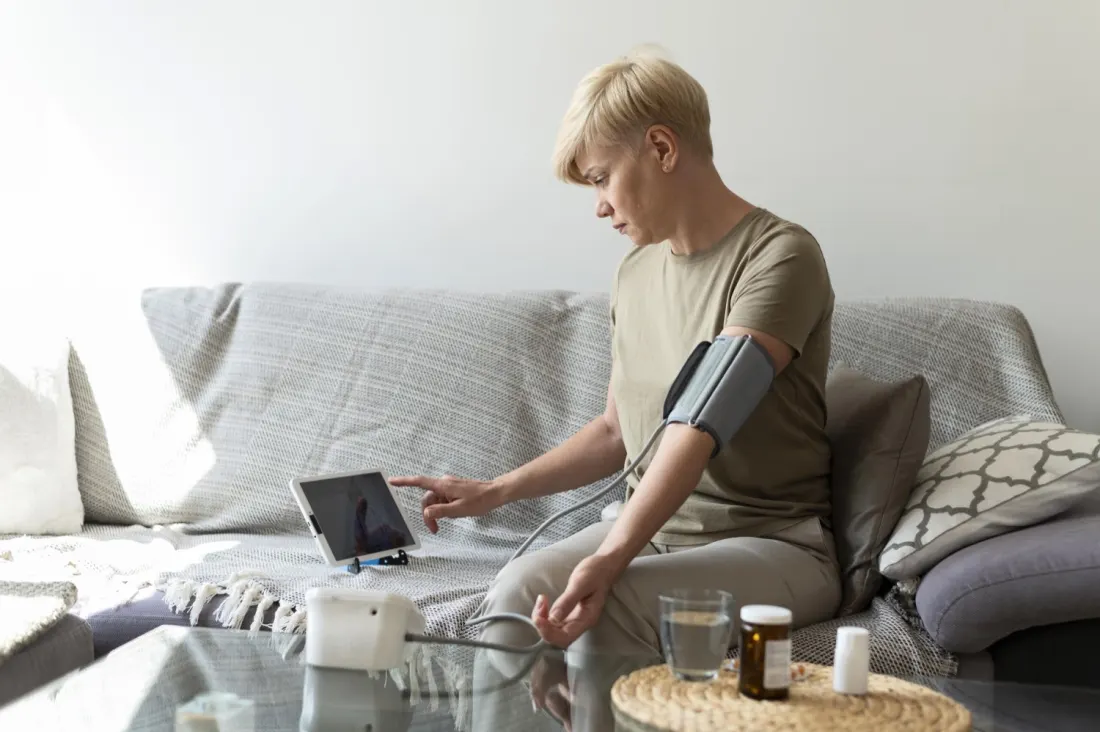
A careful repeat reading can help identify a measurement problem, but technique comes after the emergency symptom check. Use an automatic, cuff-style upper-arm monitor that has been validated and has a cuff sized for your arm. The AHA’s home-monitoring guidance advises avoiding smoking, caffeinated drinks, and exercise for 30 minutes beforehand and emptying your bladder. Sit quietly for at least five minutes with your back supported and both feet flat on the floor. Put the cuff on bare skin, not over clothing. Support your arm on a flat surface so the cuff is at heart level, and do not talk or use your phone while the monitor is running. For routine home tracking, take two readings one minute apart and record both. A too-small or otherwise incorrect cuff can produce an inaccurate result. Wrist and finger monitors are less reliable than upper-arm devices for routine home use, according to the AHA. You can search the U.S. Blood Pressure Validated Device Listing, where documentation is reviewed by an independent committee against published criteria. Bring your monitor to a medical appointment so the care team can check the fit, watch your technique, and compare it with office equipment. None of these steps should delay 911 when a severe reading comes with alarming symptoms.
- Rest quietly for five minutes before routine measurements.
- Keep your back supported, feet flat and cuffed arm at heart level.
- Use bare skin, the correct cuff size and a validated upper-arm monitor.
Use a log to make lower readings meaningful
For readings below the severe range, patterns usually teach more than one isolated number. The AHA describes a single measurement as a snapshot; a record over time gives your care team a fuller view. Log the date, time, systolic and diastolic numbers, and both readings when you take a pair. You can also record your pulse if the device displays it, any symptoms, and useful context such as recent exercise, caffeine, illness, stress, pain, or a missed prescribed dose. These notes are clues for a clinician, not proof that a high value is harmless. Try to measure under similar conditions and at the times your clinician recommends. Home readings may be used to confirm a diagnosis, and the USPSTF recommends out-of-office measurements before starting treatment for adults whose screening suggests hypertension. Repeated readings in the stage 1 or stage 2 ranges deserve follow-up even when you feel well, because the CDC notes that hypertension usually has no warning signs. Bring the log and the monitor to your appointment. Your care team can decide whether the pattern reflects persistent hypertension, a measurement issue, or another situation and can set a personal target and follow-up schedule. If a reading suddenly enters the severe range, switch from routine logging to the urgent pathway above.
- Record both numbers, date, time, symptoms and relevant context.
- Measure under similar conditions whenever possible.
- Treat a sudden severe reading differently from routine tracking.
Avoid improvised treatments for a severe reading
Do not try to force a severe reading down with an extra prescription dose, a borrowed medicine, a supplement, a special food, a cold shower, or an online “hack.” Do not stop a blood-pressure medicine or change its timing because of a home result without contacting the prescribing clinician. The AHA specifically advises against stopping blood-pressure medication based on home readings without professional guidance. If you missed a dose or took a medicine differently than prescribed, tell the clinician or emergency team exactly what happened; do not guess at a catch-up dose. Nutrition, activity, sleep, weight management and medication can all be parts of long-term blood-pressure care, but they are not substitutes for urgent evaluation when the emergency pathway applies. The NHLBI DASH eating plan emphasizes vegetables, fruit, whole grains, beans, nuts, fish, poultry, vegetable oils, and low-fat or fat-free dairy, while limiting foods high in saturated fat, sugar-sweetened drinks, sweets and sodium. DASH is a long-term eating pattern, not a rescue treatment for a severe reading. If you are losing weight, taking a GLP-1 medicine, or making major dietary changes, keep the clinicians managing those treatments informed about your blood-pressure readings and all medications. They can review the full picture and coordinate changes safely rather than reacting to a single number.
- Never add, stop or reschedule medication on your own.
- Tell the medical team about missed doses and everything you took.
- Use DASH and other habits for long-term care, not emergency treatment.
Pregnancy and postpartum care use different guidance
Pregnancy and the weeks after delivery are an important exception to the general nonpregnant-adult threshold. The CDC uses different definitions during pregnancy: high blood pressure begins at 140/90 on two readings at least four hours apart, and severe high blood pressure is 160/110 on two or more occasions. Those definitions describe clinical categories; they are not instructions to wait at home when you feel unwell. Follow the action plan from your obstetric team, and seek urgent guidance for a concerning reading or symptoms. Warning signs of preeclampsia can include a headache that will not go away, vision changes, upper-stomach pain, nausea or vomiting, swelling of the face or hands, sudden weight gain, and trouble breathing. Some people with preeclampsia have no symptoms, which is why prenatal and postpartum follow-up matters. Postpartum preeclampsia can occur after delivery, including in someone who had no history of preeclampsia during pregnancy; the CDC says it is typically diagnosed within 48 hours but can occur up to six weeks after delivery. Broader pregnancy-related complications can appear later: the CDC’s urgent maternal warning-sign guidance applies during pregnancy and for a year afterward and advises immediate medical care for listed warning signs. When pregnant or recently postpartum, do not rely only on the 180/120 framework or on a general web article. Use your obstetric team’s instructions, and call 911 for severe or life-threatening symptoms.
- Use the emergency plan provided by your obstetric team.
- Do not wait at home because a definition calls for multiple readings.
- Pregnancy-related warning signs can occur after delivery.
Common questions
Does only one blood-pressure number need to be above the severe threshold?
Yes. For a nonpregnant adult, systolic pressure higher than 180, diastolic pressure higher than 120, or both places the reading in the severe range. Symptoms determine whether the AHA pathway calls for 911 or a repeat reading followed by prompt clinician contact.
What if the repeat reading falls below the severe range?
If you have emergency symptoms, call 911 regardless of whether a later number improves. Without concerning symptoms, record both readings and follow your clinician’s existing plan; contact the care team about repeated high readings or an unusual severe result rather than assuming the first measurement did not matter.
Should I take an extra blood-pressure pill after a very high reading?
Do not add, stop or change the timing of medication unless a licensed clinician has given you specific instructions for that situation. Call 911 for a severe reading with concerning symptoms; otherwise, repeat the severe reading as directed and contact a health care professional promptly if it remains that high.
This content is for general education and is not medical advice, diagnosis or treatment. A licensed clinician can interpret your readings in the context of your health history, pregnancy status and prescribed care plan.