
Why the scale cannot tell the whole story
During weight loss, body weight tells you how heavy you are at that moment; it does not tell you whether you kept your strength or which tissues changed. Diet-induced weight loss can reduce fat-free mass as well as fat mass. Fat-free mass is broader than muscle—it also includes water, organs, connective tissue, and bone mineral—so a change on a body-composition scan is not automatically the same as a change in working muscle.
That distinction is one reason strength training matters. A 2025 systematic review and meta-analysis of randomized trials in adults with overweight or obesity found that adding resistance exercise to a weight-loss diet reduced the loss of fat-free mass, increased the loss of fat mass, and improved muscle strength compared with diet alone. It did not produce a meaningfully larger change in total body weight. In other words, the scale may move similarly while the composition and functional result differ.
Strength training is also practice for producing force: standing from a chair, climbing stairs, carrying groceries, lifting luggage, or getting up from the floor. Those abilities can improve even when scale weight slows or pauses. The useful goal is not to prevent every possible change in lean tissue or guarantee a particular body composition. It is to give your muscles a repeated reason to stay capable while your energy intake and body weight are changing.
- Judge progress by strength and function as well as weight.
- Resistance training may improve the quality of weight loss without accelerating scale loss.
Most people can be physically active, but the right starting point depends on your health and recent activity.
What the weekly guidelines actually recommend
For general health, CDC guidance separates aerobic activity from muscle-strengthening activity because each has a different job. Adults are advised to get at least 150 minutes of moderate-intensity aerobic activity per week, 75 minutes of vigorous activity, or an equivalent combination. They are also advised to do muscle-strengthening activity on at least two days per week. The strength work should cover the legs, hips, back, abdomen, chest, shoulders, and arms.
A brisk walk can support heart health, fitness, and weight management, but it does not fully replace progressive work for all those muscle groups. Likewise, lifting does not replace the aerobic part of the guideline. You can combine both in the same week without turning every session into a long workout.
“Strength training” does not mean bodybuilding or lifting a maximum weight. It means making muscles work against resistance. That resistance can come from your body weight, bands, free weights, machines, or some demanding daily tasks. A chair sit-to-stand trains the legs and hips; a wall or counter pushup trains pushing muscles; a band row trains pulling muscles; and a supported carry asks your trunk and grip to stabilize a load.
Two days is a public-health target, not proof that one exact schedule fits everyone. If you are currently inactive, a shorter routine with easier versions is a valid starting point. Consistency and appropriate effort matter more than copying an advanced split from social media.
- Include aerobic activity and muscle-strengthening activity in the same overall plan.
- Choose resistance methods you can access and perform with control.
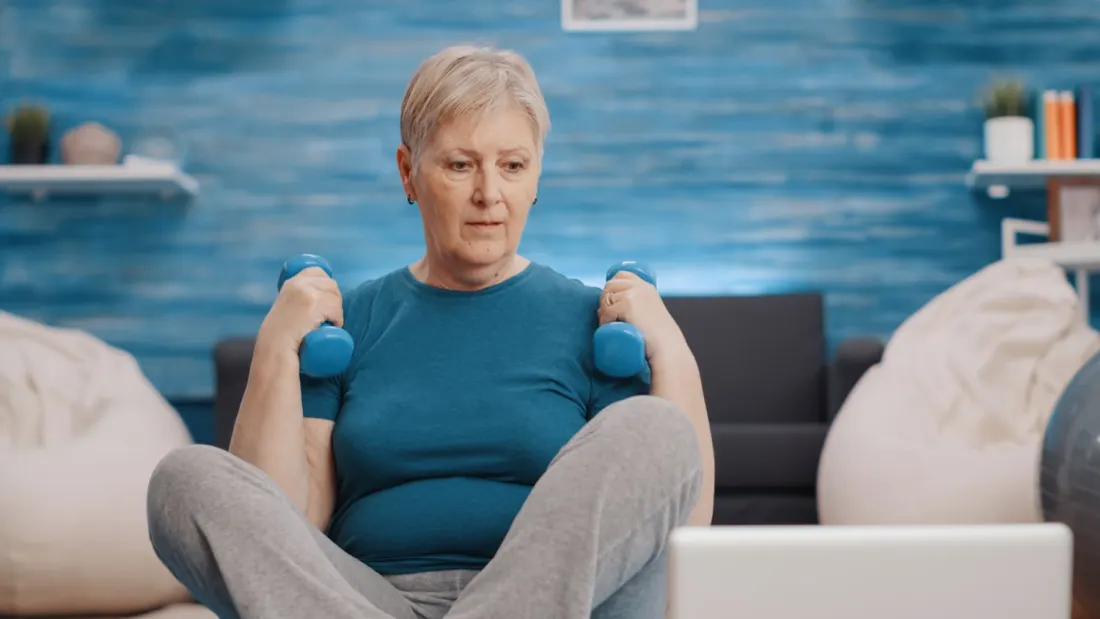
How to build a manageable starting routine
A simple full-body plan can be built around movement categories rather than a long exercise list. Include a knee-dominant movement such as a chair sit-to-stand, a hip-focused movement such as a supported hip hinge, a push, a pull, and a trunk-stability or carry exercise. The examples are not mandatory; machines, bands, free weights, and body-weight versions can all train the same general areas. Choose versions that fit your joints, balance, space, and equipment.
Federal guidance describes effective muscle-strengthening work as moderate-to-high effort. For resistance training, one set of 8–12 repetitions per exercise can improve strength, although two or three sets may produce more benefit. Treat that range as a reference, not a test you must pass. Use resistance that lets you move with control. Near the end of a set, the exercise should feel challenging, but technique should not unravel and you do not need to test your one-repetition maximum.
Progress only after the current version feels controlled and recovery is going well. Change one variable at a time: add a repetition within your planned range, add a small amount of resistance, use a slightly larger comfortable range of motion, or choose a harder variation. This makes it easier to identify what your body tolerates.
NIH guidance advises against training the same muscles on back-to-back days. A practical beginner schedule is two nonconsecutive full-body days, but the best arrangement is the one you can recover from and repeat. If soreness, fatigue, or joint symptoms keep disrupting normal life, reduce the workload and reassess rather than forcing progression.
- Begin with a small group of movements that covers most of the body.
- Increase one training variable at a time instead of changing everything together.
Safety, breathing, and when to get help
Most people can be physically active, but the right starting point depends on your health and recent activity. Before beginning, consider balance problems, significant joint or bone symptoms, recent injury or surgery, pregnancy, heart or lung disease, diabetes, high blood pressure, and medications that may affect blood sugar, heart rate, blood pressure, or hydration. These factors do not automatically rule out strength training. They can change the safest exercise, effort, supervision, or timing, so a licensed clinician or qualified exercise professional may need to individualize the plan.
Start gradually if you have been inactive. Learn the movement with a manageable resistance, stable setup, and clear space before making it harder. Breathe continuously; the American Heart Association notes that holding your breath can raise blood pressure. If you need to strain, brace, or twist just to complete a repetition, the current version may be too demanding for controlled practice.
Some muscle fatigue and mild soreness can occur when you begin a new activity. Sharp or escalating pain is not a target. Stop exercising and seek prompt help if you develop chest or upper-body pressure, extreme shortness of breath, dizziness, or feel seriously unwell. Persistent or worsening joint pain also deserves clinical review.
Pain rules and exercise limits are especially individual after surgery, during pregnancy, or with cardiovascular, lung, neurologic, bone, or joint conditions. An online routine cannot assess those risks. Use it for ideas, then get personalized clearance or modifications when your history raises a safety question.
- Keep breathing throughout each repetition rather than holding your breath.
- Stop for concerning symptoms and obtain appropriate medical help.
Recovery, nutrition, and GLP-1 medications
Strength training is the stimulus; recovery supplies the conditions for adapting to it. During weight loss, total food intake may be lower, so the quality and regularity of what you can eat matter. Protein contributes amino acids used to maintain and repair body tissues, but there is no single protein number that fits every reader. Needs and safe choices can vary with age, body size, overall intake, kidney or other medical conditions, food access, and training. A registered dietitian or clinician can help set an individualized target instead of applying a social-media formula.
If you use a GLP-1–based medication, this conversation may be more important. A 2025 multidisciplinary advisory notes that these therapies can substantially reduce calorie intake and that gastrointestinal effects can interfere with nutrition. The same advisory supports structured resistance exercise as part of care, while acknowledging gaps in direct evidence and uncertainty about the best way to calculate protein needs for people with obesity. Strength training is supportive care, not a substitute for medication monitoring.
Tell your prescriber if nausea, vomiting, diarrhea, constipation, early fullness, or another effect is making it hard to eat or drink consistently. Severe or persistent gastrointestinal symptoms, signs of dehydration, or unusual weakness need clinical attention; do not change a prescription on your own.
Sleep and rest also affect whether a routine is repeatable. If your performance drops for several sessions, soreness keeps accumulating, or daily tasks feel harder, review the whole picture—training load, food and fluid intake, sleep, illness, and medication effects—with an appropriate professional.
- Avoid adopting a universal protein target without considering your health and overall diet.
- Discuss persistent eating, drinking, or recovery problems with your GLP-1 prescriber.
How to measure progress beyond body weight
Scale weight is useful for following one trend, but it is a noisy measure of strength progress. Day-to-day changes can reflect fluid and other short-term factors, and a stable scale does not mean the training is failing. Track outcomes that match what strength training is meant to improve.
For each session, record the exercise, resistance or variation, repetitions, sets, and a brief effort note. Over several weeks, look for controlled progress: more repetitions with the same resistance, a slightly harder version with the same form, or less effort during a familiar task. Also notice function. Are stairs easier? Can you stand from a chair more smoothly? Can you carry groceries with more confidence? These observations are not medical tests, but they connect training to daily life.
Use a weekly check instead of judging a single workout. Did your plan cover the major muscle groups? Did you leave enough recovery before training them again? Did pain, dizziness, unusual shortness of breath, medication effects, or poor intake interfere? Can you realistically repeat the plan next week? If the answer is no, make the routine smaller or get help addressing the barrier before adding difficulty.
Body-composition devices can provide estimates, but their readings do not directly measure muscle quality or function and can be affected by the method and conditions. You do not need a scan to begin. A repeatable training log, functional observations, and appropriate clinical follow-up give you a broader view of whether your weight-loss plan is helping you become lighter while remaining capable.
- Track exercises, resistance, repetitions, effort, and everyday function.
- Evaluate trends over several weeks instead of reacting to one weigh-in or workout.
Common questions
Will strength training make me lose weight faster?
Not necessarily. The 2025 systematic review found that adding resistance exercise to dietary weight loss did not meaningfully increase total weight loss, but it improved strength, reduced fat-free-mass loss, and increased fat-mass loss compared with diet alone. Its main value may be improving what you retain and how you function, not simply making the scale fall faster.
Is walking enough during weight loss?
Walking is valuable aerobic activity, but CDC guidance recommends muscle-strengthening activity as a separate component. Walking usually does not challenge every major muscle group through progressive resistance. A well-rounded week can include walking or other aerobic activity alongside two or more strength-training days.
Do I need a gym or heavy weights?
No. Body-weight exercises, resistance bands, free weights, machines, and appropriately demanding daily tasks can all provide resistance. The important questions are whether the movements cover the major muscle groups, feel challenging while remaining controlled, and can be progressed safely as your strength improves.
This information is for education only and is not medical advice, diagnosis, treatment, or an individualized exercise prescription. Consult a licensed clinician or qualified exercise professional about symptoms, medical conditions, medications, pregnancy, recent surgery, or other factors that may affect exercise safety.